
A Farewell To Ar**s
Ernest Hemingway's reputation is on the rebound - and that is good for all of us.

Ernest Hemingway is one of the greatest writers of the 20th - or any - century.
That is, I am becoming increasingly hopeful, an uncontroversial statement.
Or at least, that is a statement that anyone might make without fear for their position in society. There may be people who disagree - but they can now safely be regarded with pity, rather than fear.
Only last week, for instance, Hemingway’s great World War One novel A Farewell To Arms featured on The Guardian’s list of the 100 best novels of all time - and the world continued to spin unhindered. If there was any outrage, I remain blissfully unaware.
It’s true that A Farewell To Arms should have been higher up and that there should have been more Hemingway novels on there - but I’m still taking his presence as a good sign.
It doesn’t seem so long ago that he was persona non grata. It is less than five years, for instance, that a lecturer at a well-known1 UK university told me that he would lose his job if he tried to add Hemingway to his curriculum. But it also feels like an age away.
So long ago that I now find the whole thing more confounding than anything else.
In fact, and coincidentally, just before it appeared on The Guardian’s list I was hosting a conversation about A Farewell To Arms as part of Galley Beggar Press’s monthly Critical Reading class.
I mentioned what I had been told about the unacceptability of Papa and someone asked what the objection could have been.
I was temporarily stumped.
We’d all just been reading a sad and open-hearted book about love and the pity and horror of war. It was hard to imagine why its author was so hated.
“The macho face of 20th-century prose”
Later, I took a few minutes on the internet. I was reminded that Hemingway was, as explained in a 2017 Washington Post article, the “macho face of 20th Century prose”:
Hemingway’s birth in 1899 marked the arrival of a man who wanted to dissociate literature from the taint of femininity it had acquired under the influence of Oscar Wilde and align it instead with a kind of hairy masculinity. Lilies and wallpaper were finished. In their place? Blood, battle, sex, hunts, death. Manly things. And to treat manly things properly, literature would require an appropriately manly style. Out with girly adjectives, rapt similes, elaborate metaphors, ethereal ruminations. In with curt observation, plain sentences, icy repetition.
He was also the poster boy for one of the chief cruelties of the identitarian era, the call to decolonise the curriculum:
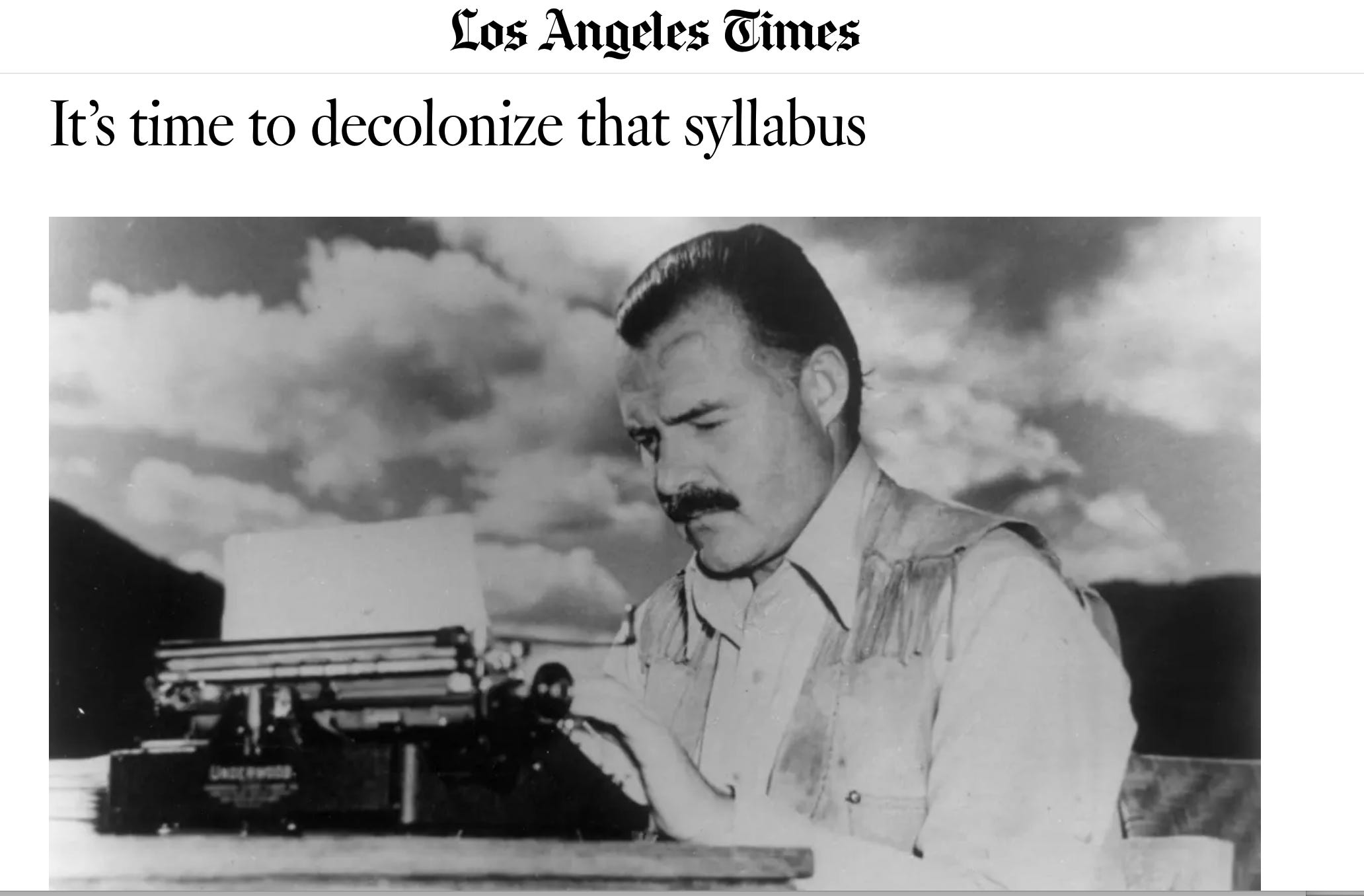
When we look back on the sad decline of English Literature as an academic subject, at least part of the blame has to go to those people who spent so long telling everyone that some of its finest exponents were variously evil, outdated and unworthy of consideration.
These were the academics and critics who not only failed to stand up for the merits of their chosen subject, but declared that it was sinful. The ones who decided that rather than facing up to the past we should obliterate all trace of it. The people who prized ignorance over engagement:
“I won’t lie,” begins one of the many hatchet jobs I found during my Ecosia trawl on hating Hemingway, “I don’t know too terribly much about Ernest Hemingway. I have not read all of his books. I have not read his memoir. I have not and do not care to do too much research into his life.”
In spite of knowing so little about him, this writer declared Papa to be “a sexist pig and an all-around bad person” and, in the true spirit of 2021 declared: “I motion to cancel Ernest Hemingway.”
A lie
The article I’ve just quoted from was written for the student newspaper for Millikin University by a young writer who was probably caught up in the fever of the times - and should almost certainly be forgiven2.
It’s also worth noting that criticism of Hemingway has an older, more established pedigree.
The most famous - and possibly the best - takedown arrived in 1978, in Judith Fetterley’s classic of feminist criticism, The Resisting Reader.
Back then, when Hemingway’s reputation hadn’t gone so far into the mincer, it must have felt riskier to attack him. Fetterley deserves credit for taking him on - and then some.
Her critique came in a chapter entitled A Farewell to Arms: Hemingway’s ‘Resentful Cryptogram’ - and I strongly recommend it. I may disagree, but I also admire Fetterley. There’s no denying her intelligence, her anger, nor her ability to bring out the blistering prose:
“And the message to women reading this classic love story and experiencing its image of the female ideal is clear and simple: the only good woman is a dead one, and even then there are questions.”
Her main contention is that A Farewell to Arms is “a lie”. It’s narrator, Frederic Henry doesn’t want his lover Catherine to survive. He would prefer to to sleep and remain a boy forever “in an asexual world without women”.
She writes:
“If we examine Hemingway's novel closely, we will discover that the emotions which in fact direct it are quite opposite from those which are claimed as central.”
This, I believe, is known as projection. When Donald Trump says his opponents are using inflammatory language, we know who’s actually blasting flames. When Judith Fetterley says Hemingway is dealing in opposites, we also know what she’s up to.
Because although Fetterley’s essay may be wonderful, it’s unsubstantiated and unbelievable.
All we need to do is apply Occam’s razor. Why would Hemingway hide his meaning like this? Why would he deal in these opposites? Why have his narrator voice page after page about love when really he hates?
A Farewell To Arms is self-evidently about adoring a woman not loathing her.
There is no reason to think that Frederic Henry feels anything other than (spoiler alert!) terribly sorry and sad about what happens to Catherine - and more broadly about what happens to women in wartime. Men too.
There is no reason to see this book as anything other than a sincere. The story is necessarily brutal - horrifying even, but it’s also tender and sweet and loving. All of which is exemplified by this rightly famous passage:
“We slept when we were tired and if we woke the other one woke too so one was not alone. Often a man wishes to be alone and a girl wishes to be alone too and if they love each other they are jealous of that in each other, but I can truly say we never felt that. We could feel alone when we were together, alone against the others. It has only happened to me like that once.
I have been alone while I was with many girls and that is the way you can be most lonely. But we were never lonely and never afraid when we were together. I know that the night is not the same as the day: that all things are different, that the things of the night cannot be explained in the day, because they do not then exist, and the night can be a dreadful time for lonely people once their loneliness has started.
But with Catherine there was almost no difference in the night except that it was an even better time. If people bring so much courage to the world the world has to kill them to break them, so of course it kills them. The world breaks every one and afterward many are strong at the broken places. But those that will not break it kills. It kills the very good and the very gentle and the very brave impartially. If you are none of these you can be sure it will kill you too but there will be no special hurry.”
I don’t doubt it.
Fetterley is talking nonsense - and so have most of Hemingway’s subsequent detractors. He didn’t lie. He wrote as truly as he knew how - and in his best work that meant that he wrote with compassion and understanding about flawed, vulnerable human beings. His heroes were not the swaggering macho men that Washington Post article describes. They weren’t even heroes.
“Did you do any heroic act?” Frederic is asked in A Farewell To Arms about his time at the front.
“No,” he replies. “I was blown up while we were eating cheese.”
Another side
I’m not here to pretend that Hemingway was perfect. He was, to put it mildly, complicated. That macho branding is partly a problem of his own making. His own myth-making, in fact:
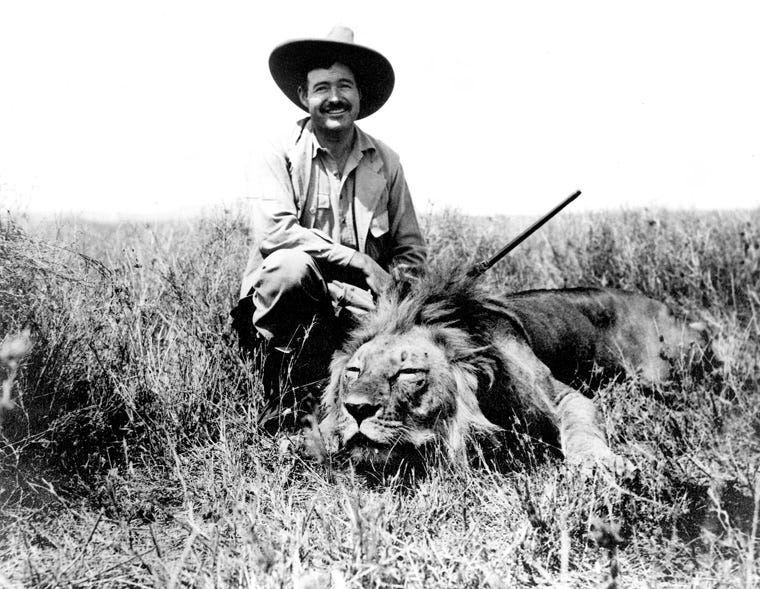
There were reasons he became unfashionable.
But his failings also make him more interesting. They are part of his tragedy - part of the damage he endured and wrote about so well. He was lost. He was suffering from what we’d now call PTSD. He was depressive. He was drunk. It all took a toll. But from that pain he produced the most astonishing prose. His writing was not only technically accomplished and full of unforgettable images and symbolism, it was also sensitive, insightful and honest. He might have messed up his life, but in his pages he often got close to perfection.
When she met Hemingway back in 1929, Dorothy Parker was already aware of his reputation and keen to make fun of it:
I have heard of him, both at various times and all in one great bunch, that he is so hard-boiled he makes a daily practice of busting his widowed mother in the nose; that he dictates his stories because he can’t write, and has them read to him because he can’t read; that he is expatriate to such a degree that he tears down any American flag he sees flying in France; that no woman within half-a-mile of him is a safe woman; that he not only commands enormous prices for his short stories, but insists, additionally, on taking the right eye out of the editor’s face; that he has been a tramp, a safe-cracker, and a stockyard attendant; that he is the Pet of the Left Bank, and may be found at any hour of the day or night sitting at a little table at the Select, rubbing absinthe into his gums; that he really hates all forms of sport, and only skis, hunts, fishes, and fights bulls in order to be cute; that a wound he sustained in the Great War was of a whimsical, inconvenient, and inevitably laughable description; and that he also writes under the name of Morley Callaghan.
But she also knew there was another side:
He has an immense, ill-advised, and indiscriminate tenderness. It is nice to note, by the dust cover of a recent novel, that its author is “a Hemingway become compassionate,” and one hastens to congratulate the lad on what must be such a pleasant change; but the original model was compassionate to start with. As always happens, the people for whom he is sorry eat greedily into his time. He is far more lavish with his sympathy than with his friendship. That goes in few directions, and is given with a little lingering, as if in the expectation of betrayal. But once you have it, there it is, and neither neglect nor bad usage can touch it.
More than that, she knew what mattered:
For it is so neat in my mind that the author of “In Our Time,” “Men Without Women,” and “A Farewell to Arms” is far and away the first American artist, that it is the devil’s own task to find anything more complicated or necessary to say about him.
Well, people do still say other things. But it’s the work that counts - and it’s the work that has endured.
Back to school
Before closing, it’s also important to acknowledge that even in his reputational nadir there were always plenty of people who read, recommended and valued Hemingway.
As well as absurd attacks on his legacy, 2021 also saw the release of a high budget (and high quality) Ken Burns and Lynn Novick documentary. Hemingway’s books continued to sell and people continued to teach him.
On that note, my own experience of holding a class on A Farewell To Arms was wonderful. Once I’d stumbled over the question of why people might hate Hemingway, we were able to focus on the book. This wonderful book.
Not everyone enjoyed it. Not everyone appreciated the iceberg method3. Not everyone was convinced by the portrayal of Catherine.
But those are literary questions and everyone present was willing and able to take the work on its own terms. I’m also glad to say that most people loved it. After all, it is a book with passages like this one:
I was always embarrassed by the words sacred, glorious, and sacrifice and the expression in vain. We had heard them, sometimes standing in the rain almost out of earshot, so that only the shouted words came through, and had read them, on proclamations that were slapped up by billposters over other proclamations, now for a long time, and I had seen nothing sacred, and the things that were glorious had no glory and the sacrifices were like the stockyards at Chicago if nothing was done with the meat except to bury it…. Abstract words such as glory, honor, courage, or hallow were obscene beside the concrete names of villages, the numbers of roads, the names of rivers, the numbers of regiments and the dates.
Sharing this book turned out to be a joy. I wish the same for many more generations of teachers and readers.
PS
Thanks for reading all the way down here! If you like the sound of giving some serious books a serious reading, please consider signing up for the next set of Critical Reading Classes. We’ve recently opened them for bookings and we’re looking at some wonderful books. Here’s a bit of blurb:
‘CRITICAL READING, CRITICAL WRITING’ is a six-month online course – hosted via Zoom – for readers, writers and everyone who wants to develop a deeper understanding of novels and how they work. It looks into the techniques of novel writing, the tricks of the author’s trade, and the decisions and craft that go into making a fantastic book. It also provides a forum to more simply discuss what these books are about, what we think of them and how much we enjoy them.
We look at six novels, at the rate of one a month. We’ll talk about the choices writers have made in putting them together, look at structure, world-building, imagery – as well as all those other bits of glue that hold a book together. We’ll sometimes talk about the stories behind the books and the act of creation. Sometimes, too, we’ll just sit back and marvel at the talent of the people we’re discussing. You can learn a lot from Katherine Mansfield, for instance. And George Saunders. Not to mention Orhan Pamuk.
You can sign up here. And here’s the roster for next time.:
Katherine Mansfield, The Garden Party and Other Stories
Jeanette Winterson, Oranges Are Not The Only Fruit
Philip Roth, The Plot Against America
Fran Ross, Oreo
George Saunders, Lincoln in the Bardo
Orhan Pamuk (trans. Erdag Göknar), My Name Is Red
Classes are held on Tuesdays at 7pm, London time. It starts in August. Let’s see how Philip Roth’s reputation is holding up… 😬
But here unnamed, for reasons I hope you understand.
People make mistakes. It’s human. It happens. Anyone who enjoys reading Hemingway has to have this understanding.
Briefly, this is the way Hemingway shows you just the snow-covered surface while somehow letting you know that great weight of the story is happening beneath the cold, dark depths. Archibald Macleish wrote that Hemingway managed: "ten things 'said' for every word written. Full of sound like a coiled shell. Overtones like the bells at Chartres. All that stuff you can't describe but only do ..."
A great piece, Sam - thank you. I do, though, think that reports of Hemingway's cancellation were always greatly exaggerated. I'd have been inclined to say to that unnamed lecturer, "Really? Why don't you *be a man*, as Pappa might have suggested, and put in on the syllabus anyway and find out?" (I've a colleague who's had "Cat in the Rain" on his syllabus forever - and gleefully gives them the "Nausicaa" bit from Ulysses too...)
I actually suspect that the "cancellation" of Hemingway is a perennial phenomenon that emerges from individual readerly/writerly journeys rather than any genuine societal reflex. He was my own second youthful literary infatuation. F. Scott Fitzgerald was the first (I am a very stereotypical boy), but having read absolutely everything I decided that whining about being rich and drunk was a bit wet, and so was having very elegant prose. So I flung myself swooning at Hemingway. THIS was how real boys should write! THIS was the writer real boys should want to be! After a couple of years I was capable of writing a reasonable parody of Bad Hemingway. But having read everything at that point, as well as several biographies, I was beginning to have some nagging doubts. Fitzgerald died of a heart attack while seemingly on the creative rebound, and his late stuff seemed sensitive and self-aware, while Hemingway...
Abrupt about turn!
I then spent several years frantically trying to rid my own writing of the Hemingway influence (in part by flinging myself in a classic oppositional rebound at Salman Rushdie and Patrick Leigh Fermor - SUCH a BOY! - which required a subsequent further purge of several years' duration). And naturally, the stylistic falling-out-of-love was coupled to a pretty critical reappraisal of the man and his apparent messages. And then, eventually, I found myself a grown up, with an attitude of, "Meh... take him or leave him, really... find the novels pretty hard to read these days, find Fitzgerald more interesting again now, funnily enough... but some of those short stories are still astonishing... and he's probably still the best figure for a young writer to fixate on while learning how to work at the sentence level..."
I reckon that's a fairly standard individual trajectory across two or three decades of a reading and writing life. I reckon we'll be individually cancelling and then partially rehabilitating Hemingway until the end of time!
I recall the first time I encountered the word “blog”. I used to enjoy relaxing with the Guardian on a Saturday. There was a feature in the arts section called something like “a roundup of the literary blogs.” This proved to be a source of much merriment and irritation. A lot of pompous arses gave their unwanted and ill-informed opinions about matters best left to their betters.
I particularly remember one comment. “I have not read X’s latest book, but I think what he was trying to say is…” The nincompoop then went on at great length to scold X for having the temerity to publish what the nincompoop had imagined him to be thinking.
This was unusual back in 1998, but is commonplace these days when nobody reads books but everybody has an opinion that can be ejaculated onto social media. Opinions are like arseholes. Everybody has got one and they all stink.