
Discovery
What we look for in a book - and how it feels to find it.

This week, some positivity1.
I want to talk quickly about a thing that helps keep publishers going: the next book. The delight of discovery. The realisation that you might well be able to bestow a wonderful gift on the world.
I want to try to explain the excitement that has gripped Elly (my co-director) and me every time we think we might have found something that we’re going to be able to publish.
It generally starts with the very first sentence. Something in the music of the language, the declaration of intent, the confidence of the writing.
I wish I could give you more clarity than that, but honestly, it’s a feeling. Almost physical. The hairs on the back of my neck go up - which is no less true for being a cliché.
This feeling is so splendid, so all engrossing, that generally I just keep reading. I plunge on into the book and don’t pause to gather my wits and freeze the memory of that first encounter. The process of discovery gets all bound up in the love I start to feel for the book as a whole; in the entire work that goes into the various stages of editorial and completion.
So I don’t have many snapshots of those precious early memories.
But there is one exception, where Elly and me caught something of this process of discovery. That’s because some of it happened via email. One day, in 2021, she sent me a message, subject line: “I think I might love this.” There was a Word doc attached.
I started reading:
“The first thing we did was change our names. We were going to be Sappho.
Who was Sappho? No one knew, but she had an island. She was garlanded with a bevy of girls. She could sit down to dine and look straight at the woman she loved, however unhappily. When she sang, everyone said, it was like evening on a riverbank, sinking down into the moss with the sky pouring over you. All of her poems were songs.”
I called upstairs to Elly.
“You only think you love it? Why aren’t you more excited.”
“I am,” she said. “I just didn’t want to put too much pressure on.”
I can’t remember how the rest of the conversation went. But I know we agreed that the sentences we had read were beautiful. I also know that we both went off to read more, right away.
And then, I felt…
… Well, again, it’s hard to describe. But actually I do have another way of trying to convey this singular rush of sensations. It’s already been put into (gorgeous) words by the poet John Keats.
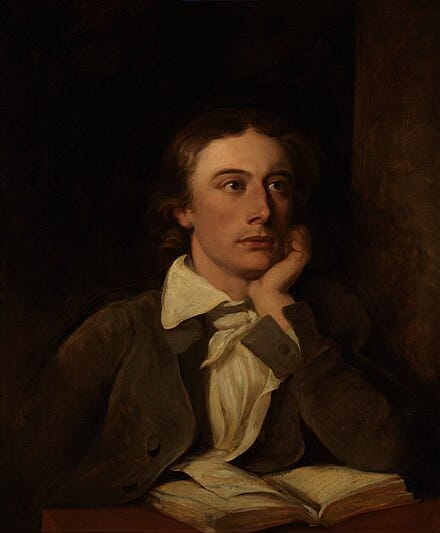
Keats, the son of an ostler, didn’t have the kind of expensive education that would give him access to Ancient Greek. So while he’d heard a lot about Homer and the wonders of the Iliad and Odysssey, he’d never been able to read the books for himself. Until a schoolmaster introduced a translation by the poet George Chapman - and, well, judging by the poem he later wrote about the experience, it hit him with the Big Oof.
On first looking into Chapman’s Homer
Much have I travell'd in the realms of gold,
And many goodly states and kingdoms seen;
Round many western islands have I been
Which bards in fealty to Apollo hold.
Oft of one wide expanse had I been told
That deep-brow'd Homer ruled as his demesne;
Yet did I never breathe its pure serene
Till I heard Chapman speak out loud and bold:
Then felt I like some watcher of the skies
When a new planet swims into his ken;
Or like stout Cortez2 when with eagle eyes
He star'd at the Pacific—and all his men
Look'd at each other with a wild surmise—
Silent, upon a peak in Darien.
A new planet swimming out of the boundlessness of space and into focus. That about sums it up.
Except, making a discovery as a publisher is even better than doing it as an astronomer, because the precious moment is sustained over hundreds of pages3.
And so it was that in 2021, Elly and me read with ever increasing delight.
The book was called After Sappho by Selby Wynn Schwartz. Every word was wonderful.
When we’d read enough to know we just had to publish it, we glanced back to Selby’s covering letter. There, she described the book as “an intertwining of sapphic histories and a fragmented, speculative, collective biography of queer feminists in turn-of-the-century Europe.” I liked that. I also enjoyed the rest of the letter, a lovely description of looking for some of our books during lockdown, the “excellent” sardines and ras el-hanout” that Selby was enjoying in Marseille - and - wait a minute.
Had this letter been written to us at the start of lockdown? Had this precious manuscript been waiting in our submission pile for over a year?
Yep. In the interests of keeping it positive, I won’t say too much in this post about how long it takes us to read submissions and the accompanying guilt, sadness and frustration. So let’s just say: it takes time. And I’m always grateful when writers are patient.
Like Selby was. We didn’t even have to hold our breath for too long after we emailed to see if her book was still available. She wrote back within a few days. We talked. And then: we had something magical on our hands.
A year later, this happened:


What joy.
Fondly,
Sam
My last two posts on Substack were also sentimental journeys through the past - as well as laments about the present. I may be entering my anecdotage.
But then, I remind myself, I’ve always complained. I got my first break by saying disobliging things about Morecambe. (Long story. Will try to tell it some time.)
So maybe it’s not a symptom of ageing. Maybe it’s a symptom of being me. But rather than follow that thought stream to its logical conclusion, I’d like to try to turn things around. Hence this article. Which will be sunny. I hope.
Cortez. I know. I sometimes read this poem to 21-year-old university students. After I’ve explained what a killer Cortez was, we have a pretty interesting discussion about understanding context and how its still possible to appreciate what a writer may be saying, even if some of their references make us feel uncomfortable in the here and now. We also talk about what right we have to judge past generations. What makes us such paragons of virtue that we are able to decry their choices? And we ask, what might later generations think of our metaphors and ideas? Then we come back to the main point that standing on that peak, and seeing all the promise of those new worlds opening up before you - well it must have been incredible.
Or a thousand, if the writer is Lucy Ellmann.