
A deep and ancient love
The bond between animals and humans preserved in Roman poetry

I’m very grateful for all the kind words and solidarity I’ve received after I posted here and in my regular Galley Beggar Press newsletter about the loss of my beautiful dog Sirius last month.
Many people have shared lovely memories of their own dogs, not to mention their sadness when they’ve lost them. It’s been a good source of solace.
Another thing that has helped console me has been thinking about how many other people over the centuries have shared this deep love for the animals they have known.
I don’t blame you if you’re thinking that that my adoration for my dog is a 21st century luxury, but I do still want to argue with you. Such love has been shared for centuries.
I’m guessing that this mutual appreciation between dogs and humans has been there ever since we first started sharing food with each other beside the fire in the cave; noticed that we had an ability to keep each other safe - and also realised that we shared a sense of humour and a desire to play together.
The place where you can really see this affection coming into focus is in the Ancient World of the Greeks and the Romans.
Think, to give just one notable instance, of the death of Argos in Homer’s Odyssey. Surely, one of the most heartbreaking moments in all literature?
This comes when Odysseus returns home at last to his island home on Ithaca, in disguise. He finds his old companion on a pile of manure, neglected and withering, but still able to muster just enough strength to recognise his master with joy – before dying.
Odysseus (who has watched dozens of his shipmates perish without giving them a second thought) weeps. Because, of course he does. He loves this faithful friend.
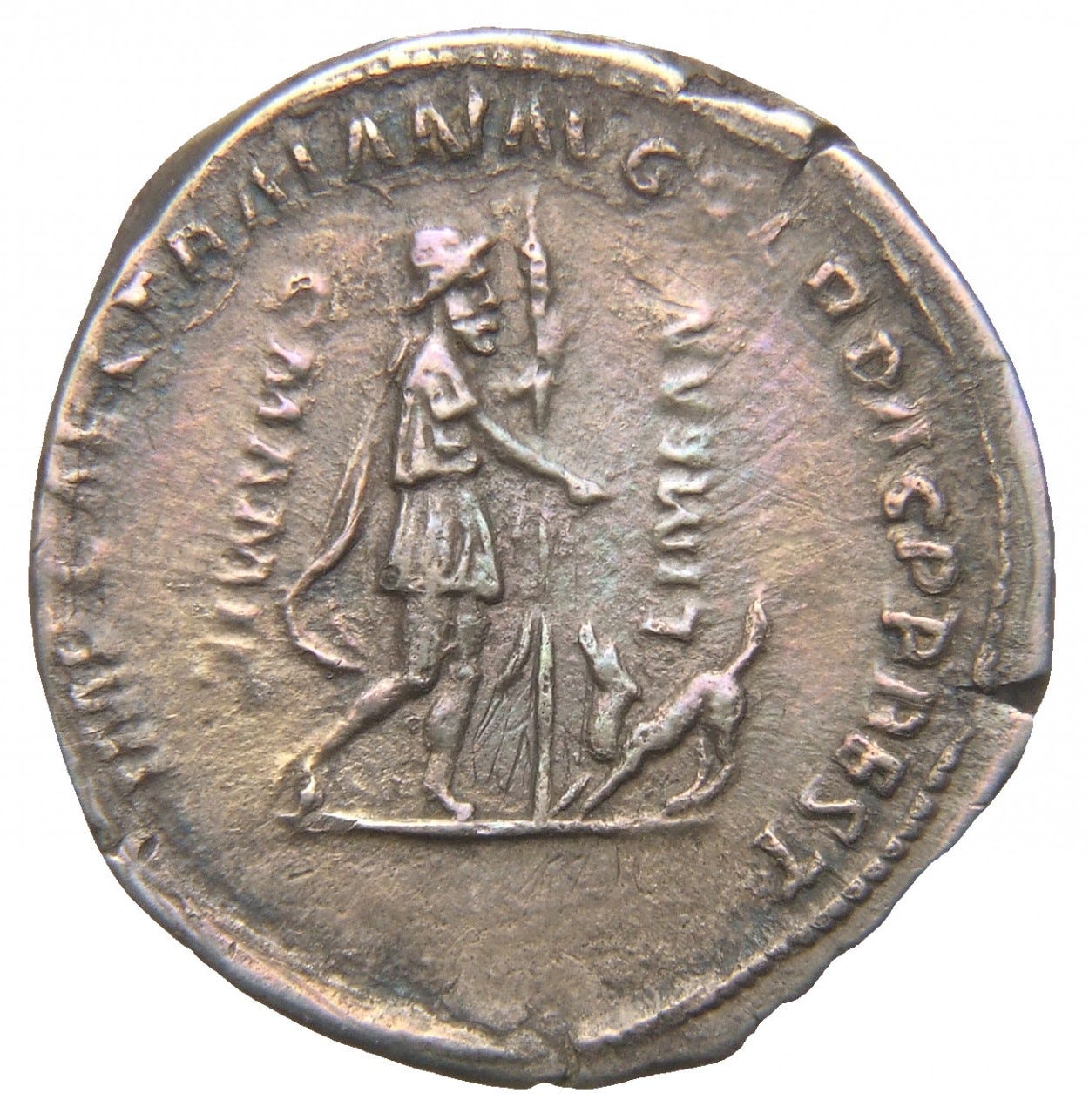
Argos was a hunting dog: a professional. In the Ancient World canines often had to earn their keep.
The evidence we have from the Romans is that they used sleek greyhound-style dogs for hunting. They kept big, fierce ancestors of our rottweiler breeds to guard their property. And they bred smaller lapdogs as a fashion accessory for the elites.
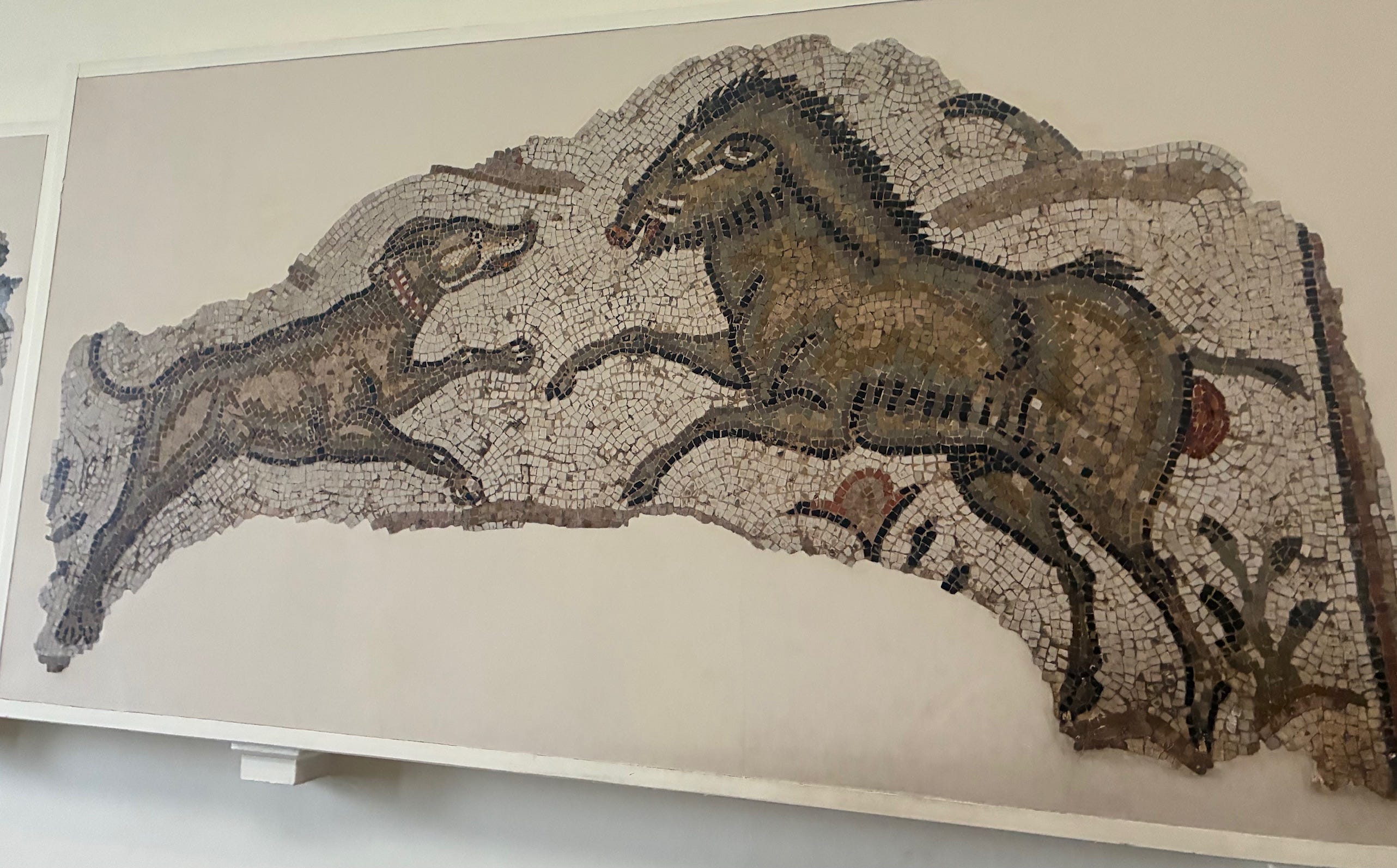
So far, so utilitarian. But archaeological research has also found that these dogs were well-cared for. There is little evidence of abuse among Roman dog skeletons – and quite a bit of evidence of good feeding and pampering (especially among those lap dogs).
There’s also considerable evidence that many of Romans loved their animals. The emperor Hadrian is said to have had tombs made for his dogs and horses because he loved them so much. Less famously, but even more touchingly, there are also dozens of heartbreaking funerary inscriptions dedicated to dogs, noting the owners’ tears as they carried them to burial, the animals’ good nature and nobility in life, the happy years of shared friendship.
In the British Museum, for instance, there is a marble plaque written from the point of view of a hunting dog called Margarita, the words painstakingly composed and chiselled into stone, detailing her whole life and career:
“Gallia gave birth to me and the oyster the rich sea gave me my name – fitting to my beauty. I was trained to bravely run through unknown forests and to flush furry animals from the hills. I was never used to be held by heavy chains or endure savage blows on my snowy body. I was used to lying on the soft lap of my master and my mistress and knew to go to bed when I was tired on my spread matress. And I never spoke more than allowed to a silent mouthed dog and no one was scared by my barks. But now I have been overcome by death from an ill-fated birth and earth has covered me beneath this small piece of marble. Margarita.1”
And then, there’s this heartbreaker:
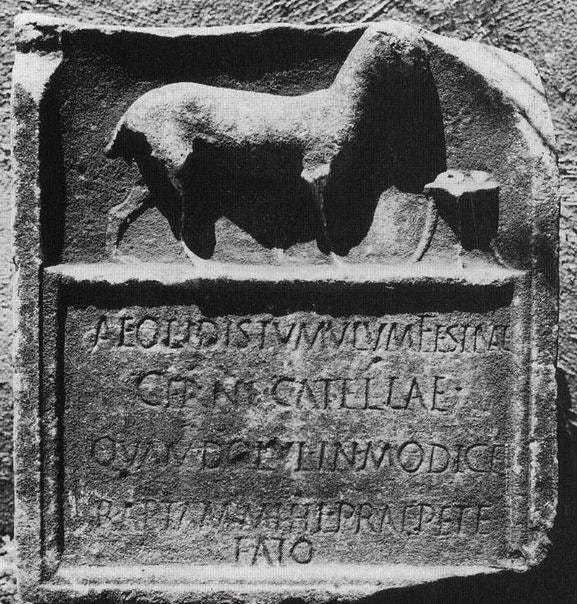
That reads:
“This is the tomb of Aelois, the cheerful little dog. I suffered pain beyond measure when she was snatched from me by fate2.”
And, oh boy, don’t I feel the same, two-thousand years later?
Another stone (this time from Greece) reads, more simply:
“If you happen to see this monument, laugh not, l pray, though it is a dog’s grave. Tears fell for me, and the dust was heaped above me by a master’s hand.”
That inscription is heartbreaking – but also quite possibly correct in the assumption that there’s also something funny about these declarations of love for mute animals. There’s bathos as well as pathos in our fervent declarations about companions who are never able to express their opinions in words and have no say on how they might want to be remembered.
What would they make of all this fuss?
We can’t know.
But still, somehow, they urge us to recall them.
Odd, sad feeling.
The shadowy road
The Roman poet Catullus had this mix of emotions covered. He didn’t write about dogs, more’s the pity, but he did understand something about the misery of losing a beloved creature, as well as the strange comedy of writing about it.
Here’s his poem about the death of his lover’s pet sparrow:
Grieve, o Venuses and Cupids
and every one of the loving people;
My girl’s sparrow is dead,
the sparrow who was the delight of my girl,
whom she used to love more than her own eyes.
For he was a honey and knew her
as well as a girl knows her own mother
and he did not move from her lap
but hopping around, now here, now there
only used to chirp to this girl alone:
he who now goes on this shadowy road,
from which they say no one at all returns.
But may you suffer, dark shades of Orcus
Who devour everything that is beautiful.
You stole such a pretty sparrow from me
O wicked deed! O poor little sparrow!
It’s your work that now my girl’s
eyes, are rubbed red raw by weeping.3
These lamentations are gloriously over the top. That image of the tiny bird, toddling along that dark road to the underworld is also amusing.
In fact, I should now admit that there’s more going on here.
This poem is a follow-up to another, detailing how much the same girl loves this poor little sparrow.
Sparrow, the delight of my girl,
with whom she used to play, whom she held in the fold of her lap,
to whom she used to give her finger tip in ardour,
and used to incite harder bites.
When I want to play some sweet game
with my own shining eyed desire -
as small solace for her pain,
I believe that then heavy passion gives way;
I am able to play with you just as she does
And lighten the sad cares of my soul4.
It’s not impossible that the poem is indeed about a real pet bird. We know from artistic representations that Romans did keep caged birds. But, of course, there is a potential double meaning for this thing that so enjoys leaping here and there in Catullus’ girlfriend’s lap; for this thing he’d like to play with by himself to lighten his spirits.
And if you keep that symbolism in mind there must be a double meaning in the other poem to the fact that this ‘sparrow’ has encountered such sudden and shocking dysfunction before making its way to the underworld.
It’s funny. It’s making light of the funeral dirge, the excess of emotion and sentiment we feel about mute animals – and also our obsession with our own genitals. Catullus’ original Latin compounds the absurdity by piling on deep ‘groaning o’ and ‘u’ sounds:
“Lugete, o Veneres Cupidinesque,
et quantum est hominum venustiorum:
passer mortuus est meae puellae”
Can you hear it?
I like to picture him reading it with force and gusto.
I like to picture him enjoying himself.
And yet.
There’s also something real here. Catullus brings in genuine darkness. Yes, the image of that little chirping sparrow making its way down the shadowy tunnel to the underworld is amusing. The image of a flaccid penis attempting the same journey is even funnier. But there’s horror there too. There’s real sadness. Death, after all, is no laughing matter.
We are made to question a lot in these two poems, and although they are full of double meanings and double entendres, there is one thing that is straightforward: the fact that the girl is weeping – and has wept so much that her eyes are red and raw.
Taken together, these two poems say something rather moving about life with pets. They tell of the delights we share – but also there is always a cost because we can not share them for long enough.
This thought had resonance in the ancient world, just as it does for us today – and for me this minute, still grieving for my own darling dog.
Poignantly, a marble plaque has been found in France, thought to date from the second century AD, dedicated to another dog - called Flea – and clearly based on Catullus’ poem and its various emotions:
How sweet she was and how good natured!
She who while she was still alive she used to lie in the lap,
sharing always sleep and bed.
O wicked deed Flea, that you perished,
you who only barked if some rival took the liberty
of lying up against your mistress.
O wicked deed Flea, that you have died,
that now the deep grave holds you and you know nothing about it -
and you are not able to go nuts nor jump around
nor do you bear your teeth at me with gentle bites…5
Yes, the going nuts. The wonderful dancing excitement of dogs, paws scittering, legs everywhere, tongue lolling, tail up and down and round, ears back and up and eyes shining.
That’s how I want to think of my dog Sirius too. That’s how he was, in fact. There was the agony of parting and the red eyes – but before that I had ten beautiful, lucky years with him. Every minute I spent with him in those years he brought me joy.
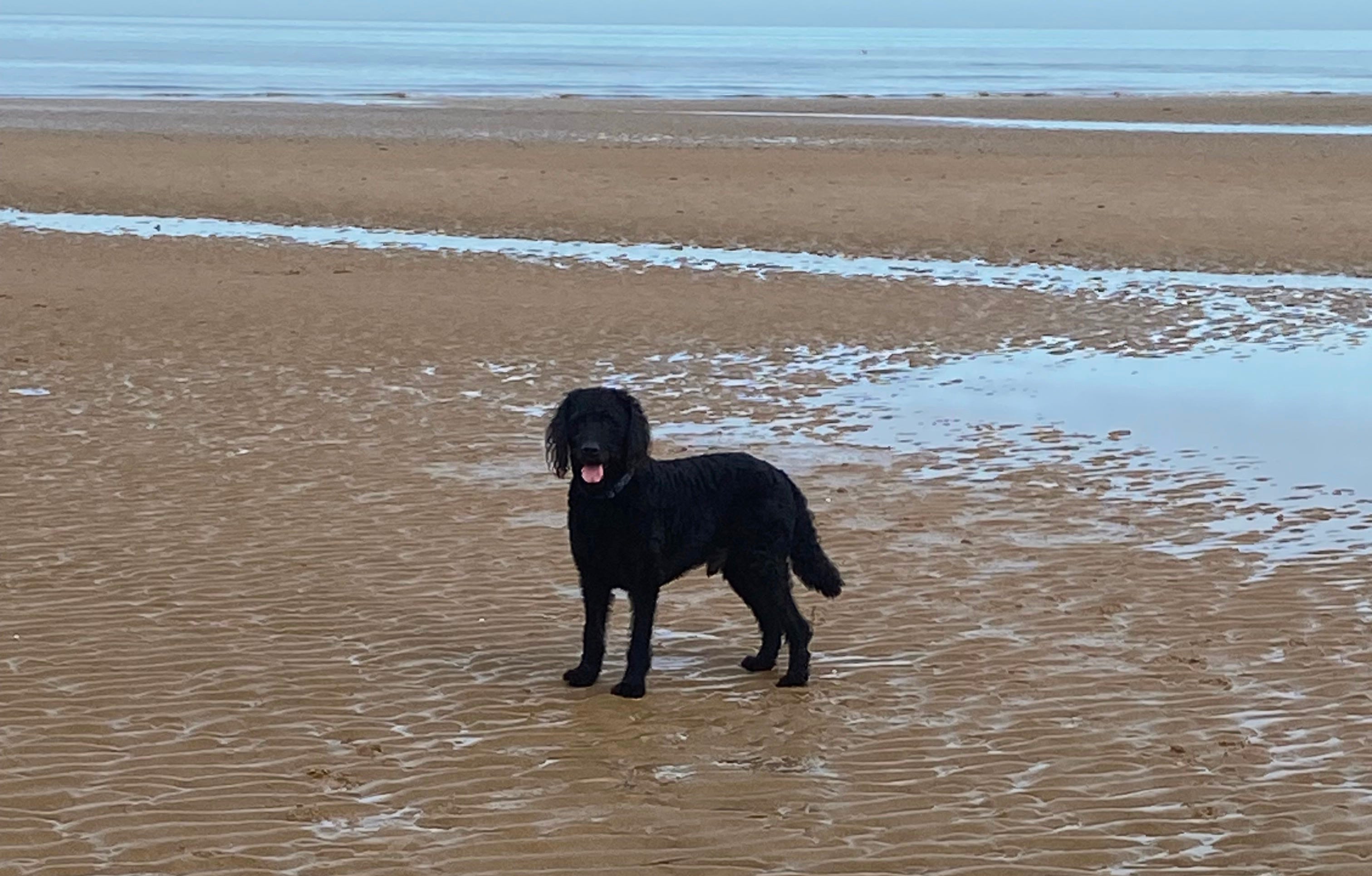
It’s moving to think that Romans knew similar delights. That we share such things in spite of all our other differences.
It’s also moving to know that so many other dogs have also received the adoration they deserve and inspired such heartfelt tributes to that love.
And maybe, in a way, that’s what writing is for. To pin that love to the page – or to carve it in stone. It’s our attempt to stop death from being able to snatch away everything. To ensure that this best part of us doesn’t just disappear…
Elsewhere…
Deborah Zafer has launched a campaign to get the wonderful writer Rebecca West a blue plaque in London. I wrote a letter to lend my weight to the campaign - and urge anyone else who knows how good this writer is to get involved too. You can read my letter and find out about the campaign on Rebecca’s Substack:

I’m teaching at Arvon
The poet Jo Bell and I are running a course on reading like a writer in the beautiful Devon countryside in May. The course is designed to encourage you to produce new material based on reading together, writing together, and engaging in lively conversation about the writers who most inspire us… I’d love you to come. Details here!
Gallia me genuit nomen mihi divitis undae concha dedit formae nominis aptus honos docta per incertas audax discurrere silvas collibus hirsutas atque agitare feras non gravibus vinc(u)lis unquam consueta teneri verbera nec niveo corpore saeva pati molli namque sinu domini dominaeque iacebam et noram in strato lassa cubare toro et plus quam licuit muto canis ore loquebar nulli latratus pertimuere meos sed iam fata subii partu iactata sinistro quam nunc sub parvo marmore terra tegit Margarita.
Aeolidis tumulum festivae
cerne catellae,
quam dolui inmodice
raptam mihi praepete
fato.
Lugete, o Veneres Cupidinesque,
et quantum est hominum venustiorum:
passer mortuus est meae puellae,
passer, deliciae meae puellae,
quem plus illa oculis suis amabat.
nam mellitus erat suamque norat
ipsam tam bene quam puella matrem,
nec sese a gremio illius movebat,
sed circumsiliens modo huc modo illuc
ad solam dominam usque pipiabat.
qui nunc it per iter tenebricosum
illuc, unde negant redire quemquam.
at vobis male sit, malae tenebrae
Orci, quae omnia bella devoratis:
tam bellum mihi passerem abstulistis
o factum male! o miselle passer!
tua nunc opera meae puellae
flendo turgiduli rubent ocelli.
Passer, deliciae meae puellae,
quicum ludere, quem in sinu tenere,
cui primum digitum dare appetenti
et acris solet incitare morsus,
cum desiderio meo nitenti
carum nescio quid lubet iocari,
et solaciolum sui doloris,
credo, ut tum gravis acquiescat ardor:
tecum ludere sicut ipsa possem,
et tristis animi levare curas!
Quam dulcis fuit ista quam benigna
quae cum viveret in sinu iacebat
somni conscia semper et cubilis
o factum male Myia quod peristi
latrares modo si quis adcubaret
rivalis dominae licentiosa
o factum male Myia quod peristi
altum iam tenet insciam sepulcrum
nec sevire potes nec insilire
nec blandis mihi morsib(us) renides.
So sad and yet so funny. That Catullus!
I do love the photos you've been posting of Sirius. You would not believe that a black dog could express so much personality in a snapshot. He is just so joyful in all of them.
Have you come across the children's book Love That Dog, by Sharon Creech? Written in verse by a boy named Jack who is studying poetry with Miss Stretchberry, it takes us through William Carlos Williams and Robert Frost inexorably towards a Bad Thing that happens to Jack's dog Sky. Best introduction to poetry for Year 7 that I know, but also makes everyone weep, write acres of sad verse and bring in plasticine statues of their dead bunny rabbits.