
Links, tips and suggestions
Reading suggestions, interesting links and important ideas from the literary world. (III)

[A reminder in case you are new here that this is a place where I share tips about books and publishing - and also interesting stories in the literary world. Some of those I will find - but I warmly welcome reader contributions in the comments. (They are open!)]
Hello!
Welcome to the third instalment of this new iteration of Links, Tips And Suggestions. I think we’re deep enough in that I can soon stop the counting and welcoming and get straight down to business.
And on that note…
…There are books to read and stories to tell. So let’s hit it.
Booker Prize longlist announced
The 13 nominated books for the UK’s biggest literary prize are:
Love Forms by Claire Adam (Faber)
Universality by Natasha Brown (Faber)
One Boat by Jonathan Buckley (Fitzcarraldo Editions)
Flashlight by Susan Choi (Jonathan Cape)
The Loneliness of Sonia and Sunny by Kiran Desai (Hamish Hamilton)
Audition by Katie Kitamura (Fern Press)
The Rest of Our Lives by Ben Markovits (Faber)
The Land in Winter by Andrew Miller (Sceptre)
Endling by Maria Reva (Virago/Little, Brown)
Flesh by David Szalay (Jonathan Cape)
Seascraper by Benjamin Wood (Viking)
Misinterpretation by Ledia Xhoga (Daunt Books Originals)
Excitingly, that list features the first Booker Prize author whose surname begins with the letter X: Ledia Xhoga.
Beyond that, I can’t say much, because I haven’t read any of the books1. But! The Times have done a very useful guide- and an unusually enthusiastic one. They identify just “one dud.” (Click on the link to discover which one that is.)
Good news
Jane Austen “is on course to have her best year since 2009.” I bet she’s thrilled. On her 250th too.
Joking aside, there are some fascinating stats in the Bookseller article providing this revelation. She’s sold 78,000 copies in the UK in first 28 weeks of 2025 - up from 64,000 in the same period last year. Which is a lot of Austen. Especially considering the fact that those are just the figures from Nielsen (who record sales through the tills of participating bookshops) - and so don’t include the huge numbers of Austen books that must have been sold second-hand.
In other words, hundreds of thousands of people in the UK will probably have read something by Jane Austen this year. And hundreds of thousands of people in the UK are almost certainly just a little bit better for the benefit of her wisdom, humour and facility with semi-colons. Maybe there is some hope, after all.
In fact, while we’re feeling good, and since we’re all friends, let’s enjoy the first sentence of Persuasion:
Sir Walter Elliot, of Kellynch Hall, in Somersetshire, was a man who, for his own amusement, never took up any book but the Baronetage; there he found occupation for an idle hour, and consolation in a distressed one; there his faculties were roused into admiration and respect, by contemplating the limited remnant of the earliest patents; there any unwelcome sensations, arising from domestic affairs changed naturally into pity and contempt as he turned over the almost endless creations of the last century; and there, if every other leaf were powerless, he could read his own history with an interest which never failed.
It only gets better after that. “You pierce my soul.” My god. Why hasn’t she sold more?
An actual benefit from AI
An article I’ve been writing about the evils of literary AI will be arriving here on Substack very soon. But for the sake of balance, some news of a more wonderful thing.
Google have developed an AI tool that is helping scholars fill in the gaps in Roman inscriptions.
There are thousands of inscribed texts, scattered all over the empire, often full of writing from ordinary people, recounting fascinating details of their day to day lives and concerns - but hitherto very hard to read thanks to the ravages of time. Now a pattern recognition system seems to be filling in a few of those frustrating gaps and whole new mines of information may be about to open up.
“It promises to be transformative,” says the great Cambridge Classics professor Mary Beard.
Add that to the ongoing work to read the voclano-charred scrolls at Herculaneum and we might be about to get an awful lot of fascinating new material relating to the Ancient World.
Curses
Angelo Hernandez Sias writes wonderfully about the difficulties of translating José Donoso in n+1:
“THE OBSCENE BIRD OF NIGHT is a cursed book. Its first translator, already a stand-in, disappeared from the project under mysterious circumstances. Its second translator, tapped to finish the job, never translated another book. Its third translator, some fifty years on, has been asked to revise rather than re-translate, grafting excised segments onto a nearly five-hundred page tome. Its author, who meant to knock it out in a few months, got lost in it for seven years, at the end of which he suffered his third bleeding ulcer, received an infected blood transfusion, had an allergic reaction to morphine, and nearly threw himself from a hospital window.”
Yikes.
Meanwhile:
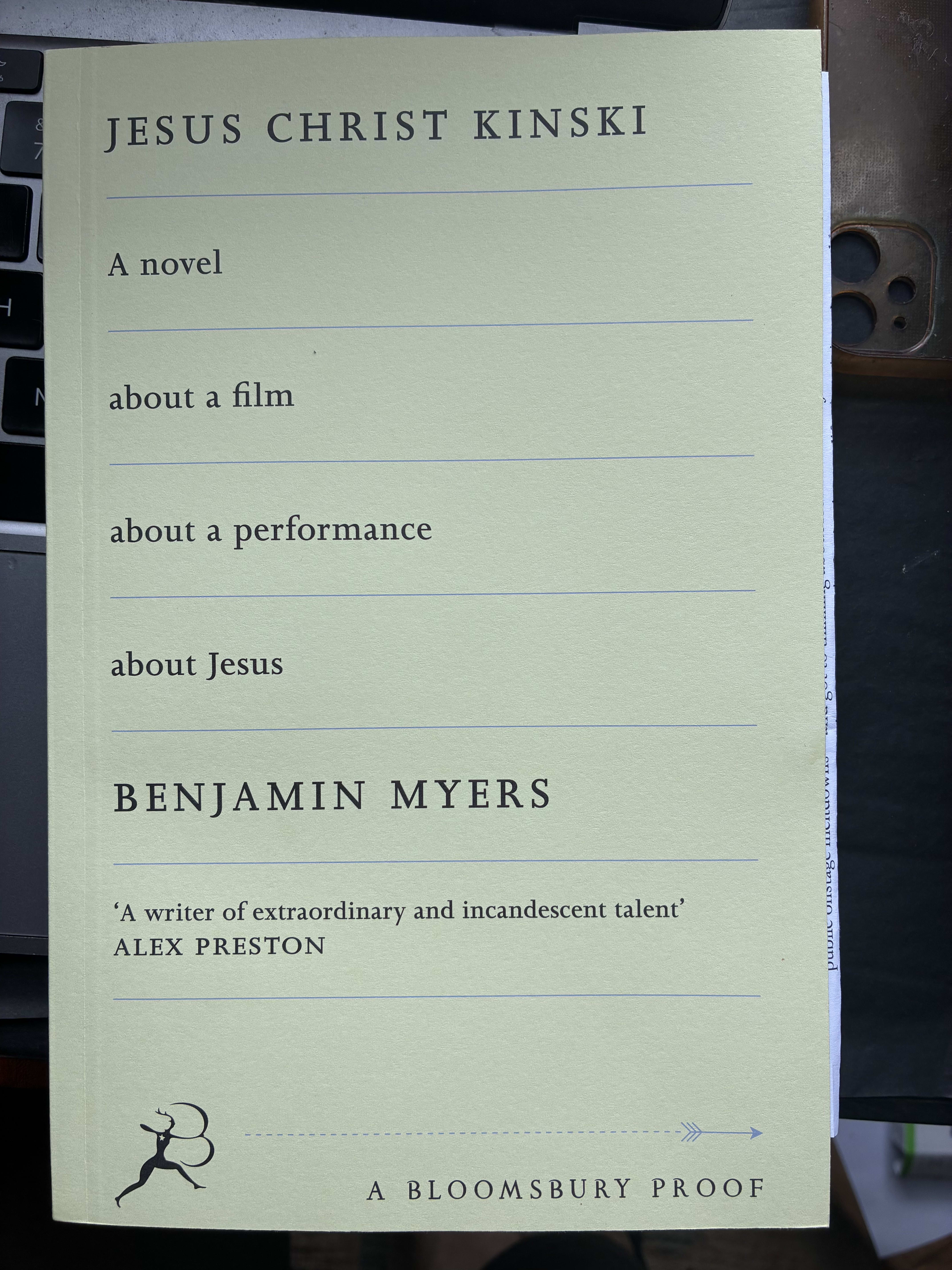
That came through my door this week. It’s out in October and looks extraordinary. Sample page:
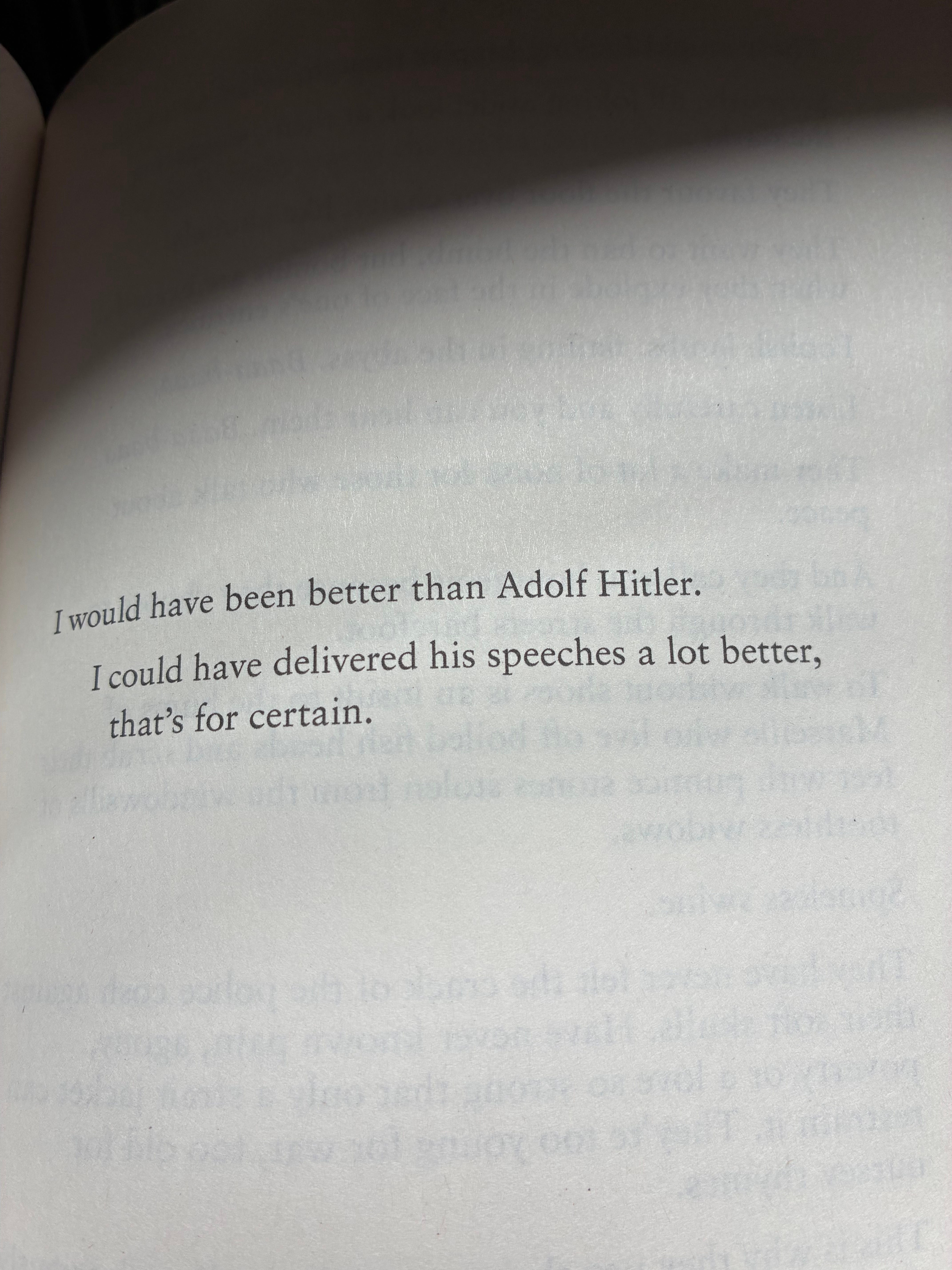
Klaus Kinski, it’s safe to say, was not like us. Benjamin Myers, meanwhile, just keeps on putting out wonderful novels. I’m looking forward to this one.
Talking of October releases, I’ve just put in my order for this:
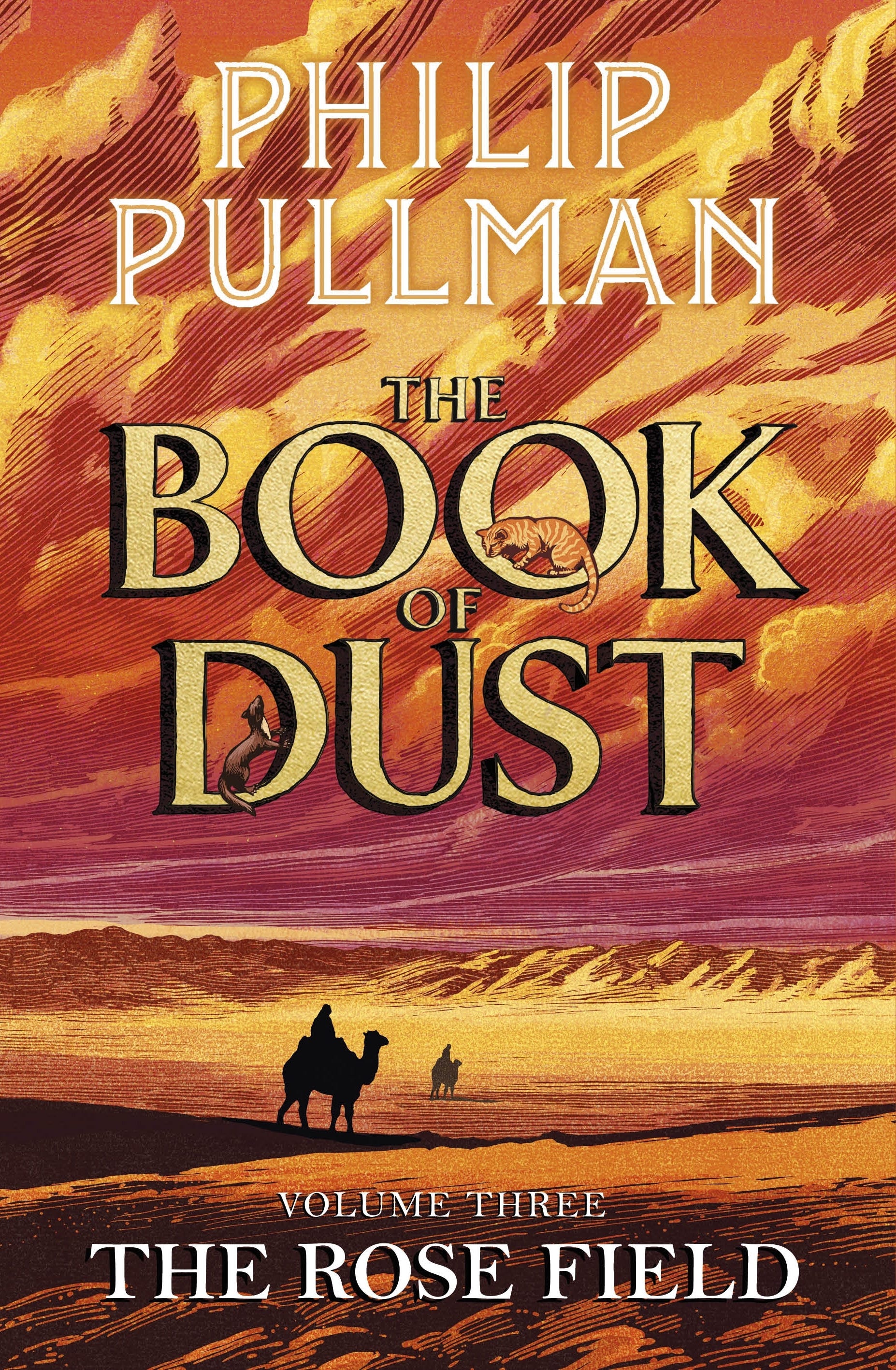
Whoop!
Otherwise, I’m currently reading Leonara Carrington’s The Hearing Trumpet for the Galley Beggar Critical Reading Class:
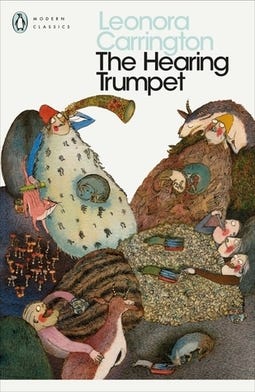
It’s very funny. Dark too. But very funny. I’ve also been surprised to realise that Carrington grew up in the same village as me - Cockerham, near Lancaster. (Sadly, we weren’t there at the same time.) She even drew quite a painting of her house:
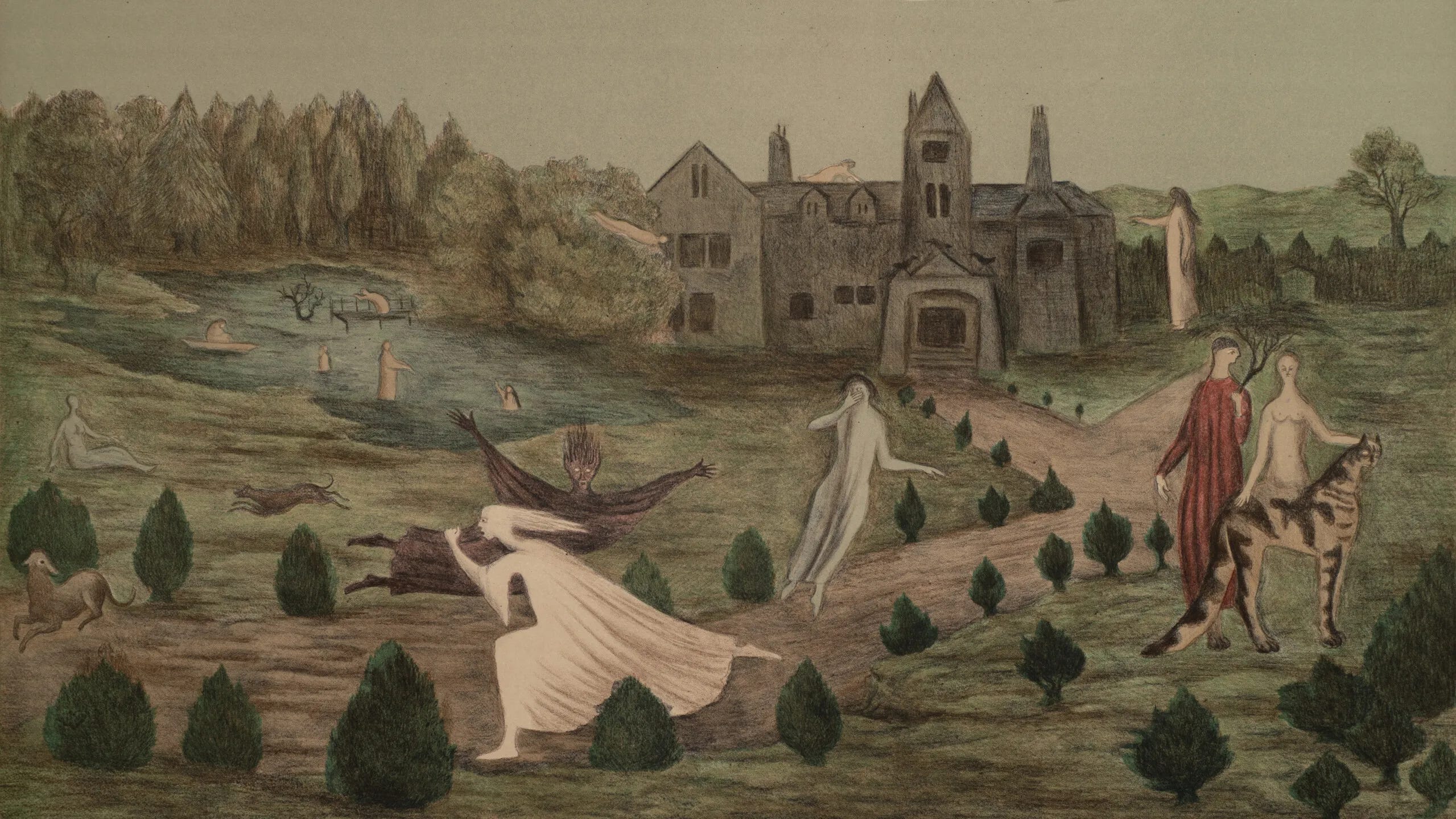
When I lived in Cockerham, this place, Crookhey Hall, was owned by Liverpool City Council and used as special residential school for boys. My own, much smaller, primary school played football against them once. The pitch was near where Leonora has drawn a lake, as I recall. We lost 26-0. The worst thing was that they were actually going easy on us…
Your recommendations
Thank you for all the kind words and comments on the previous Links, Tips and Suggestions post and various parts of Substack.
A few quick highlights:
Tom Mooney writes:
Hello hello! Glad to see this thread back after so many years away.
Talking of Goodreads... I see so many articles like the one you posted, and so many descriptions of it as a cesspit. But I'm fairly active on there and I've almost always found it a fairly constructive place to share things. I guess it just depends what you want to get out of it. That said, authors should never go on there - it's probably bad enough reading one review of your books, let alone hundreds of them.
In terms of current reads... I just finished Fall, Bomb, Fall by Gerrit Kouwenaar, an excellent little Dutch classic that will be published in English for the first time in September. It's like a mix of Catcher in the Rye and Catch-22. Charming, funny and tragic. If only it were a bit longer.
Sounds wonderful.
And here are two excellent recommendations from hudsonettle:
I have recently read The Eights (2025) by Joanna Miller. In 1920 women were first allowed to study for a degree at Oxford University. This novel follows the lives and experiences of four (fictional) young women from different backgrounds studying there in their first year. Flashbacks are included to provide the background for each of these characters and show how they came to study in Oxford and how World War I had affected their lives. The author combines her fictional story with historical details such as the lists of rules for female students and real persons, Winifred Holtby and Vera Brittain. As far as I can tell, it is a worthy description of this time.
I have also listened to Colm Tóibin’s Long Island (2025), having first reread Brooklyn (2009). In the recent sequel we meet up again with Eilis, who had left Enniscorthy in Ireland twenty years previously to improve her prospects and had married into an Italian-American family in Long Island. The past catches up with her when she returns for a visit and her mother’s 80th birthday. I can’t attempt to describe the author’s skill in presenting the ensuing story from three perspectives so delicately and the issues and themes that pervade this novel.
Elsewhere, Nigel Warman recommends the great John Kennedy Toole and A Confederacy of Dunces. “And while we are at it,” he adds, “The Neon Bible is well worth a read too.” Correct!
Let’s end with an especially good one. Rachel Tribble suggests the HG Wells classic The Time Machine: “Every sci-fi conspiracy theory we exist with today started here !! 😂😍 I have fallen in love all over again with this incredible ride!”
In which I recommend myself
Ahem. I was honoured to be asked to provide some more of my own book recommendations on Mathew Lyons fantastic series of interviews, The Writer’s Bookshelf:

This is a series in which he asks writers about their formative reads, current reads - and more. The full list is here. I’m in very good company.
Oh! Almost forgot. The annual Galley Beggar Press Short Story Prize is now open for entries. Please send in yours! Details here.
That’s enough for now. If you have recommendations of your own, please do share them in the comments below. And I’ll be back with more soon.
Fondly,
Sam
PS Thanks for reading all the way down here. I do have one more thing: Galley Beggar Press is still having a summer sale. 35% off backlist titles. That’s a lot of good books for not much money. Enjoy!
Okay, one quick comment. I was on the judging panel for the Edgehill short story prize the year David Szalay won for Turbulence. It was an excellent book and he was a very gracious winner. I didn’t think as much of his previous Booker short-listed novel (not least because it definitely wasn’t a novel) All That Man Is. But I’ve heard good things about
Hey Sam, great to see you helming a Tips, Links and Suggestions column once again. The old column was a favorite on-line destination.
I read The Hearing Trumpet two years ago and I absolutely loved it. It had an off-kilter echo with Mrs Palfrey at the Claremont, more chemically altered but equally as joyful.
I've been immersed in long-term attempt at wrangling the post-Modernists. I've been immersed, sporadically, in Pynchon, Gass, Coover, Calvino and enjoying the ride. This time around I read John Barth's Lost In the Fun house, which was a somewhat uneven collection of linked short stories. A few were brilliant, a few were stinkers. A few, they must have been brilliant at the time they were published.
Afterwards, I visited a favorite author who, in retrospect, might bridge the post modernists with Dickens. I read Zadie Smith's In Beauty and loved it. Surely, she must be modern Britain's Charles Dickens. Her odd characters, her reliance on coincidence, her penchant for zaniness, her perfectly sculpted humans with their loudly beating hearts.... She's wonderful, I think and from her I accept a level of narrative kookiness and literary rail-jumping that I would not be able to take from most other authors. I don't know if she can do no wrong quite yet, but even if she does faceplant a book or two, I:m more than happy to faceplant alongside her.
I would like to recommend The Oppermanns by Lion Feuchtwanger, which I finished reading last week. It was written in 1933 as Adolf Hitler rose to power. It is a chilling read and, unfortunately, still relevant to the endangered democracies of our time.
I love Andrew Miller and Benjamin Myers' books, and looking forward to reading their latest.
Finally, after your post, Sam, I started re-reading my much worn out copy of Jane Austen's Pride and Prejudice. Just what is needed after The Oppermanns.