
Links, tips and suggestions
The place to discuss literary news and the books you're reading. Featuring a real hero, comically evil AI,

Elder States Man
On 24 January, a Minneapolis citizen declared, “I’m 70-years-old and I’m fucking angry”, before disappearing into a wall of gas thrown by ICE agents.
Here he is, on the other side:

As if his actions weren’t already symbolic enough, it turned out that this man is called Mark Ketter and he’s the proprietor of the comics and fantasy bookshop, Dreamhaven Books.
Yes, that’s a bookseller holding the line against ignorance, state violence and people without empathy.
That’s a bookseller giving us a reason to hope, in spite of everything1.
“We don’t want it to be known that we are working on this.”
Comically evil AI-slop mavens Anthropic have recently had to settle a class action law suit for industrial scale theft of copyrighted works - but it turns out that getting hold of all those pirated ebooks was only part of their evil plan.
A newly released tranche of documents has revealed that they also intended to scan and digitise “every” book in existence - and to destroy the physical copies of the books in the process.
The Washington Post have reported that in the filings Anthropic state:
“Project Panama is our effort to destructively scan all the books in the world. We don’t want it to be known that we are working on this.”
I wonder why?!
It seems that Anthropic were buying up books in their thousands, ripping them up, ingesting their contents, and then destroying them. It’s almost as if they wanted to create a metaphor for US tech capitalism and its approach to humanity….
Not everyone hates us
Whisper it, but the UK Labour government are slowly starting to do better things for the book world. Like a recent multi-million pound pledge to UK libraries. There’s a long way to go, but at least it’s starting to feel like, for the first time in over a decade, the UK government doesn’t actively want to destroy us. Some things are getting better…
Isn’t pseudo profundity exactly what we need in these troubled times?
A splendid article in The New York Times claims that Don DeLillo, author of Underworld, Libra and White Noise, also invented the “racy hockey novel2.”
In 1980, writing under the pen name Cleo Birdwell, the great man put out a book called: Amazons: An Intimate Memoir by the First Woman Ever to Play in the National Hockey League.

It’s a faux-memoir of a woman who gets to play, in more ways than one, in the US Hockey League. They even put a picture of the spoof author on the back cover:

Gerald Howard, once an editor of Don DeLillo describes the book in detail in this Bookforum article. He says it is “a total laugh-so-hard-you-reach-for-your-asthma-inhaler hoot.”
Sample lines:
“Isn’t pseudo profundity exactly what we need in these troubled times?”
““If a man’s name sounds right whether you say if forward or backward, it means he went to Yale”"
Murray Jay Siskind (who DeLillo fans will know from his memorable appearances in White Noise) even has a cameo.
Bafflingly, DeLillo has distanced himself from Amazons. He’s refused to allow it to be republished and the author Jonathan Lethem, who says the book (which influenced his own work) is “insanely funny” also told the New York Times:
“I had the experience of seeing his face when I placed a copy in his hands. He said in a characteristically direct, quiet, uninflected voice, ‘I don’t autograph that.’
Ouch.
Unhinged
I also enjoyed this article about people reading Wuthering Heights for the first time, and discovering just how much it is:
“74 pages into wuthering heights and why did nobody tell me that reading this is like eavesdropping on the most unhinged gossip you’ve ever heard,” went a TikTok summary posted by Toini Ilonummi, 30, who lives in the San Francisco Bay Area. “I’m obsessed.”
I mean - yes! - among other thing3.
Your recommendations
Okay! On to the good stuff.
Noémi Kiss-Deáki4 tells us she is recommending:
Christian Kracht’s Air to everyone I meet. Completely wonderful in a way that is difficult to put in words. I could say it is about an interior designer invested in a way of life he sees as the most robust and aesthetically pleasing (never buying bread from anywhere else than a specific bakery,wearing fisherman’s clothes, favouring certain materials, fabrics, natural environments...) getting a job from a design magazine he is a great admirer of to find the ‘perfect white’ colour for... the interior of a huge AI data centre, it turns out. At the same time we follow a 9-year-old girl in what seems like ancient times accidentally shooting a man with strange ways and, it seems,superior knowledge... plot wise, I could try and describe some of it this way but in the end one just has to experience this book.
Fran Ross’s Oreo has been getting more love. Neural Foundry writes:
I stumbled across this one a couple yrs ago at a used bookstore and was blown away how it got slept on for so long. The Yiddish-Black vernacular mix creates rhythms that are basically untranslateable, which makes it even more impressive how effortlessly the humor lands.
M.J. Hines adds:
I agree on Oreo, the charm of which it’s almost impossible to capture - people should just read it.
And also says:
Right now I have been sucked into the vortex of Solvej Balle’s On The Calculation of Volume, and I don’t think I’m going to escape any time soon
Margaret O’Brien suggests The Colony by Audrey Magee:
Longlisted for the Booker, shortlisted for The Orwell Prize, this is set on a small, thinly populated island of the west coast of Ireland. The year is 1979. Two visitors come to spend summer on the island, to ‘capture’ an authentic community, one through visual art, the other through language. But the ‘troubles’ and politics of the North of Ireland spill over even into this isolated place. I loved how Magee wove reportage (appalling incidents of violence committed by both Republican and Loyalist paramilitary groups) through her fiction here. A brilliant book.
We have a book of last year recommendation from Annabel Gaskell:
Muckle Flugga by Michael Pedersen - the debut novel from the current Scottish Makar5. It’s a coming of age story set on Shetland’s northernmost (formerly) inhabited island with its lighthouse. The lighthouse keeper is a stern man of repressed emotions who doesn’t understand his son, who is otherworldly, a bit neurodivergent, a passionate reader and craftsman, and motherless (she is presumed dead). When they take on a bird-watching artist as a lodger in the island’s other cottage for some extra cash, the relationship between father and son will come to a climax as the son gets a feel for the mainland world through the lodger. Beautiful, poetic, very Scottish, I fell hard for this novel.
Time for a big book. Liz S has enjoyed listening to Lori Feathers talking about Agaat, by Marlene Van Niekerk, on The Big Book Project.
I read this Afrikaans novel, translated by Michael Heyns, some time ago and, as Lori says, it’s extraordinary. Two women, one black and one white, have to deal with the effects of Apartheid and, in different ways, the extreme challenge of motor neurone disease (ALS). It’s a long novel and quite a tough read. The themes are similar to those in The Promise by Damon Galgut, which won the Booker. The Promise is a good book but for me it was always overshadowed by the more powerful Agaat.
Finally, Anna Joy Jarvis has two ‘great’ books for us:
Love’s Labour by Stephen Grosz. I loved his first book, The Examined Life, which was all case studies. In Love’s Labour he mixes them up with some memoir pieces too, and all are characterised by his limpid, precise sentences and his profound perspective on love and desire. The other, quite different, was The Scent of Flowers at Night by Leila Slimani. It’s a novella-length memoir piece about a night she spent alone in the Punta della Dogana museum in Venice (a kind of writerly installation, if you like). It’s really mostly about the act of writing and Slimani’s genesis as a French-Moroccan writer. I thought it was beautiful and intriguing.
That sounds good to me!
One last thing
We’ve just started taking pre-orders on our next Galley Beggar Press release: How Do People Stay The Same by Mark Bowles.
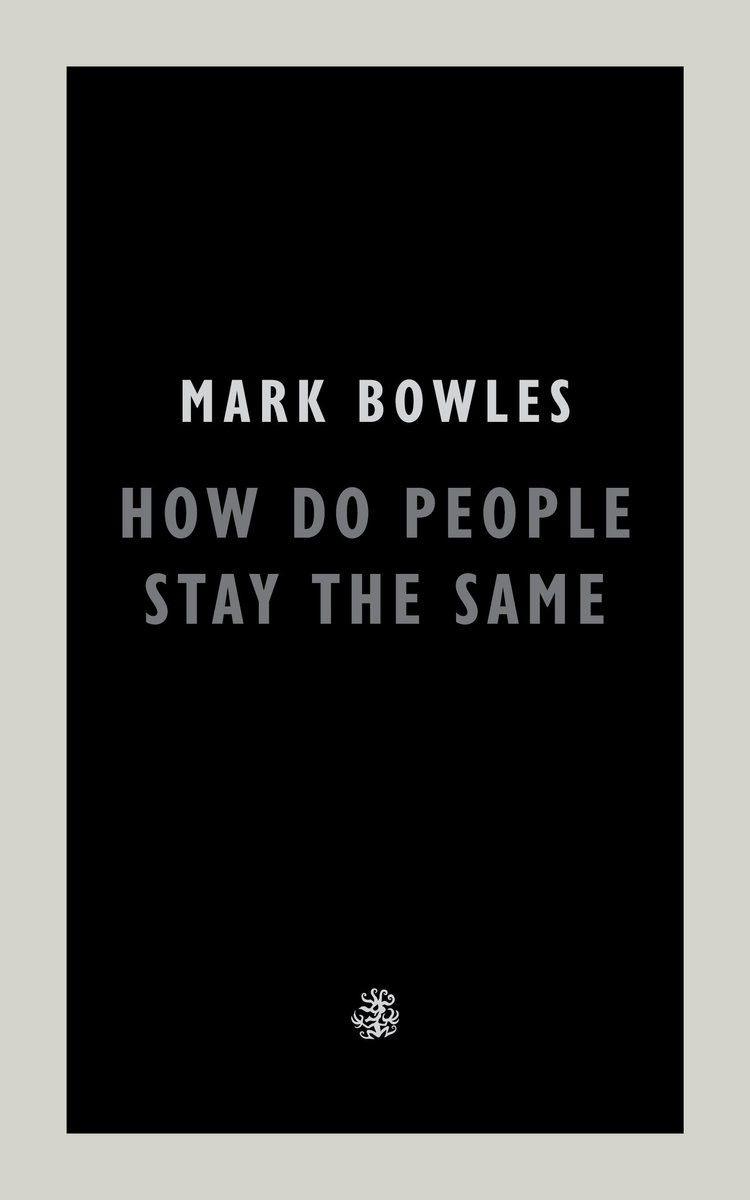
It is a thing of wonder and beauty. It’s up on our online shop - and there are more details in our most recent newsletter.

I’d suggest making a purchase from Dreamhaven’s online shop, but I’m late on that one, and it looks like they’ve already been overwhelmed. But if you’re moved to support them, why not put a notch in your calendar to pick something up in a couple of months when things are quieter. After all, April is a cruel month at the best of times: https://dreamhavenbooks.com
I didn’t know this was a thing, either. Apparently it’s popular in the US thanks to a TV series called Heated Rivalry.
One sour note from that article. I look forward to the day when certain kinds of Americans stop trying to make everything about their very particular problems with race. For instance:
“Without the racism that Heathcliff experiences, there is no book: That is the central conflict, and driver to the plot, in my opinion.”
Imagine trying to explain that to someone from early 19th century Haworth, like, say Emily Bronte… Or indeed trying to explain it to anyone who has read the book without being blinded by the obsessions that come from living in such a cruelly divided country. I know everyone reads a different book, and sees something of themself in it. And that’s fine. But even so. No need to reduce Wuthering Heights quite so much…
That’s right! The wonderful author of Mary And The Rabbit Dream!
The Makar is the National Poet for Scotland: https://en.wikipedia.org/wiki/Makar_(National_Poet_for_Scotland)
This month I had a real nostalgia trip with Homework by Geoff Dyer, his memoir of growing up in Cheltenham in the 60s & 70s. His writing is so evocative of the era. Brooke Bond cards anyone?
Thanks Sam for including my book suggestion, The Colony.