
Papa do preach
Ernest Hemingway was one of the first and most eloquent anti-fascists. He had their number early, he loathed them accordingly and he tried to warn us.

I recently wrote a few words in praise of Ernest Hemingway’s great novel A Farewell To Arms. But not enough of them.
Soon after I hit publish I started to reflect on the fact that I had, among other things, failed to highlight one of the book’s most commendable – and sadly, most relevant – qualities.
I hadn’t mentioned that this novel is, also among other things, a furious and courageous piece of anti-fascism, a 300-page two-fingered salute to Mussolini and all his works – and a direct challenge to the dictator’s attempts to write and enforce his own version of Italian history.
The good news is that because this is Substack, I now get a chance to address that oversight. And it turns out that this important and fascinating element of the novel is worth an article in itself:
A bomb waiting to go off
In June 1922, Ernest Hemingway was in Milan with his wife Hadley, revisiting places where he had recuperated from the wounds he received as a Red Cross ambulance driver on the Italian front in 1918.
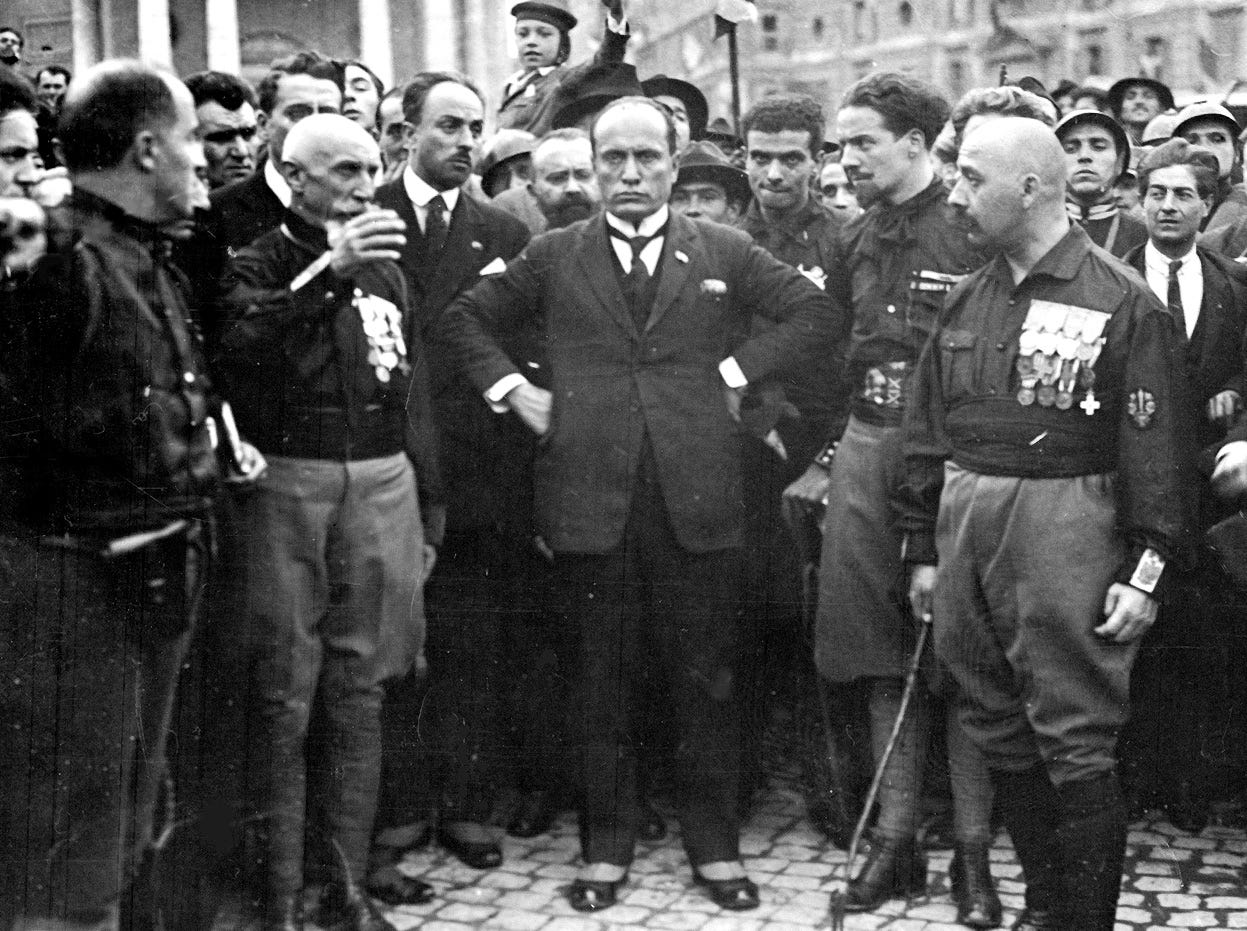
Benito Mussolini was also in town, in the offices of Popolo d’Italia; the newspaper he was still editing as he gathered around him an army of street fighters and black-shirted thugs.
Hemingway, then a reporter for the Toronto Star, managed to blag his way into a meeting with the would-be dictator:
“Mussolini was a great surprise,” he wrote. “He is not the monster he has been pictured. His face is intellectual, it is the typical ‘Bersaglier’1 face, with its large, brown, oval shape, dark eyes and big, slow speaking mouth.”
Even so, Hemingway was not taken in. He remarked that Mussolini was “a patriot above all things” (then, as now, a remark that only a certain kind of person would take as a compliment). He pointedly asked what Mussolini intended to do “with his political party organised as a military force.”
He concluded:
“The whole business has the quiet and peaceful look of a three-year-old child playing with a live Mills bomb.”
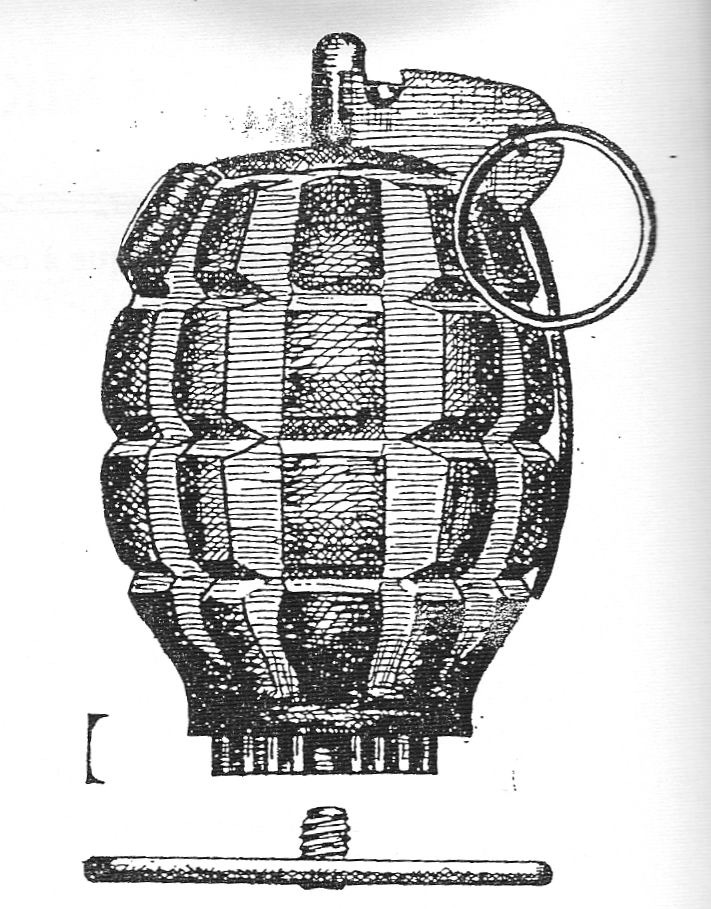
That October, Mussolini took his mob,2 marched on Rome and became the Prime Minister of the kingdom of Italy.
“The biggest bluff in Europe”
Hemingway soon met Mussolini again. Both men attended a conference in Lausanne in July 1923, which was supposed to settle the conflict between the Allied powers and the former Ottoman Empire in the First World War.
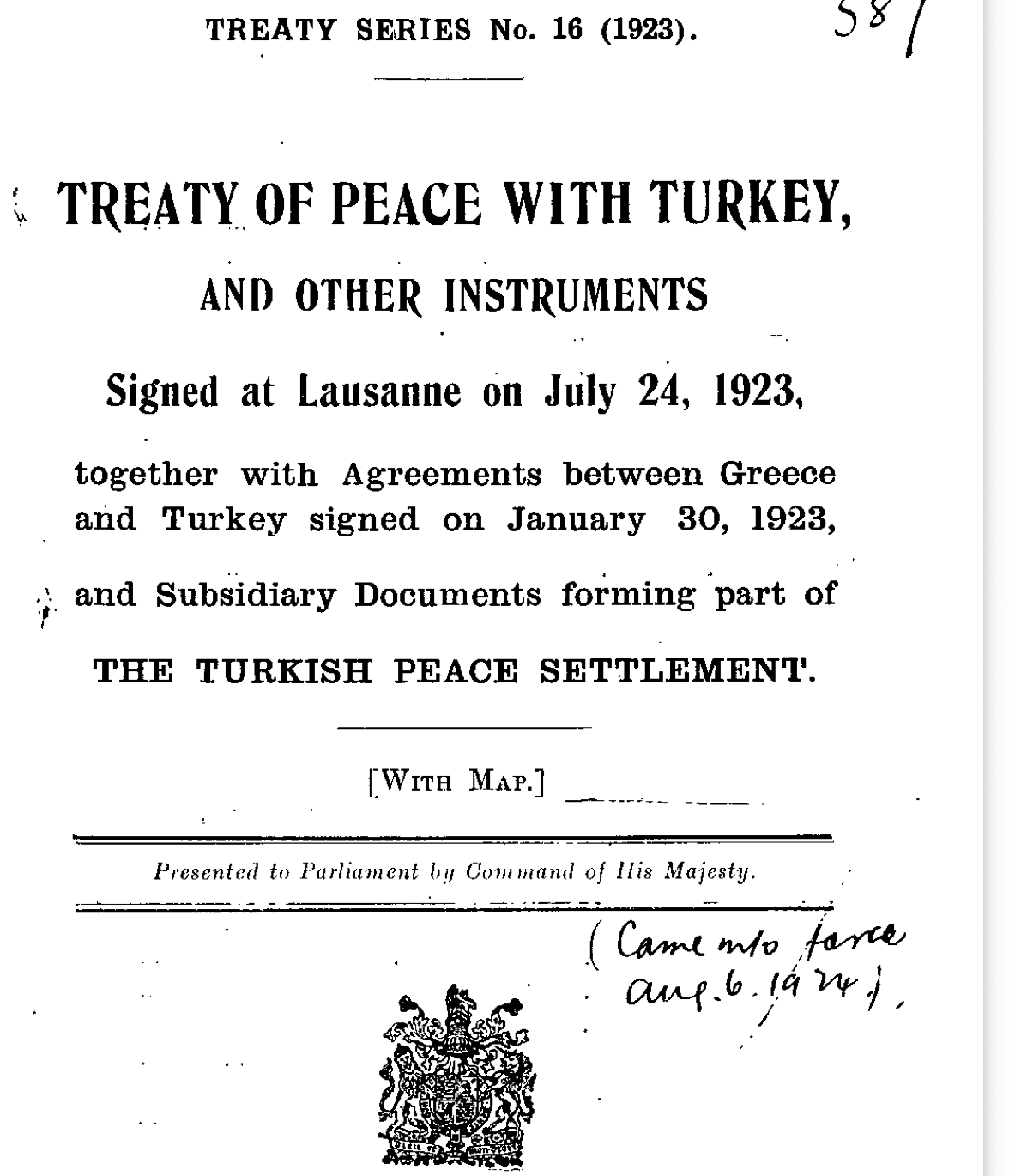
Hemingway was there as a journalist. Mussolini was there to representing Italy - and was a figure of considerable interest, as Hemingway reported back to readers of The Toronto Star: “The Fascist dictator had announced he would receive the press. Everybody came. We all crowded into the room.”
Hemingway’s description of what followed should have ended fascism then and there:
Mussolini sat at his desk reading a book. His face was contorted into the famous frown. He was registering Dictator. Being an ex-newspaperman himself he knew how many readers would be reached by the accounts the men in the room would write of the interview he was about to give. And he remained absorbed in his book. Mentally he was already reading the lines of the two thousand papers served by the two hundred correspondents. “As we entered the room the Black Shirt Dictator did not look up from the book he was reading, so intense was his concentration, etc.”
I tiptoed over behind him to see what the book was he was reading with such avid interest. It was a French-English dictionary – held upside down3.
Hemingway had Il Duce’s number. He knew he was a bullshit artist. He also wrote:
Mussolini is the biggest bluff in Europe. If Mussolini would have me taken out and shot tomorrow morning I would still regard him as a bluff. The shooting would be a bluff.
Hemingway did his best to teach his readers to see through this bluff. And here in the 21st century, where we have so many similar monsters, we too should heed his lessons:
Get hold a good photo of Signor Mussolini sometime and study it. You still see the weakness in his mouth which forces him to scowl the famous Mussolini scowl that is imitated by every 19-year-old Fascisto in Italy. Study his past record. Study the coalition that Fascismo is between capital and labor and consider the history of past coalitions. Study his genius for clothing small ideas in big words. Study his propensity for dueling. Really brave men do not have to fight duels, and many cowards duel constantly to make themselves believe they are brave. And then look at his black shirt and white spats. There is something wrong, even histrionically, with a man who wears white spats with a black shirt.
Fascists, Hemingway knew, as early as 1923, deserve derision and contempt.4
Less amusingly, Hemingway also warned:
“Mussolini isn’t a fool and he is a great organizer. But it is a very dangerous thing to organize the patriotism of a nation if you are not sincere.'“
“Italy chortles”
Viewed retrospectively, it seems like Hemingway was doing no more than pointing out the obvious. Of course Mussolini was insincere. Of course he was dangerous. Of course he was ridiculous.
Here in 2026, we all know what was waiting for Mussolini in the Villa Belmonte in April 1945.
But in the 1920s, few people were able to see ahead so clearly. Another impressive thing about Hemingway’s denunciation is that he made it in the face not only of popular opinion, but in the spite of many of his literary peers – and people who had the potential to help his career.
1923 was two years before he published his first short story collection, In Our Time – and six before he became globally famous with the publication of A Farewell To Arms. 1923 was also just one year before Hemingway started writing for the transatlantic review – a periodical partly set up and hugely influenced by Ezra Pound.
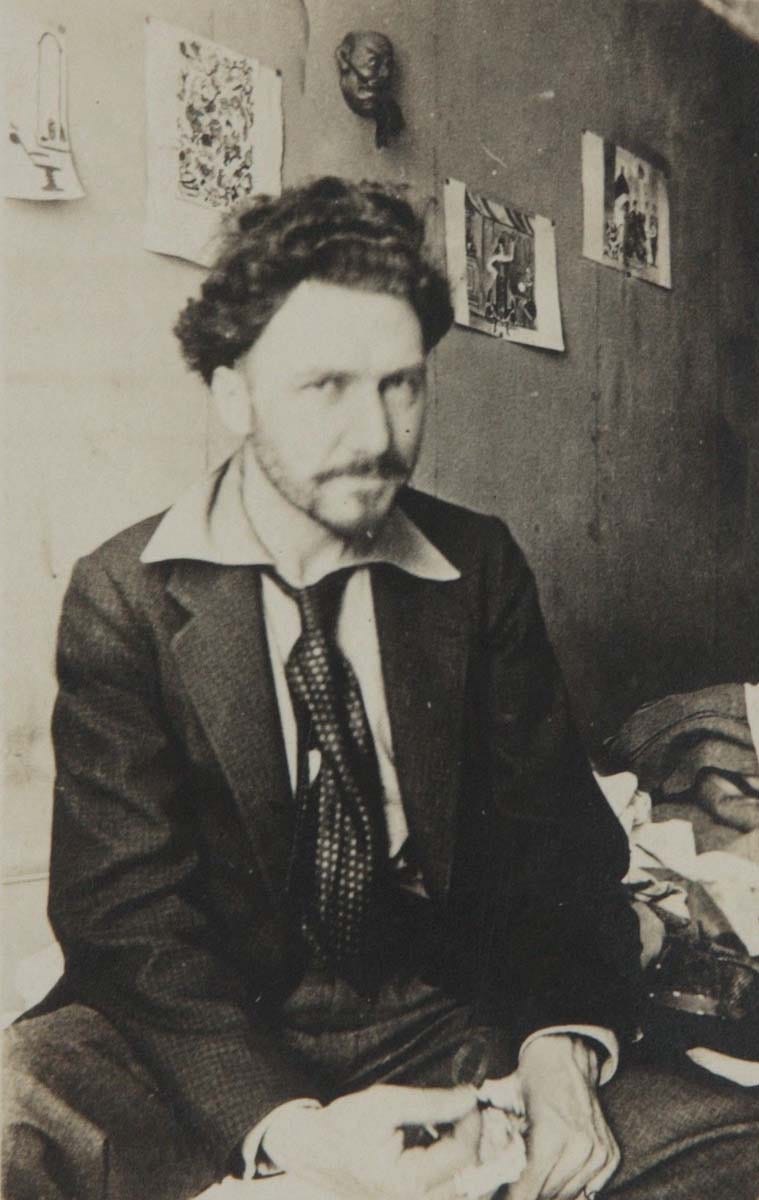
Ezra Pound was everywhere. The Waste Land had just been published, dedicated to him (in Italian!) as il miglior fabbro. He knew everyone in Paris. He had left England under a cloud a few years earlier, but the influential editor AR Orage had still declared:
He has been an exhilarating influence for culture in England; he has left his mark upon more than one of the arts, upon literature, music, poetry and sculpture; and quite a number of men and movements owe their initiation to his self-sacrificing stimulus.
Pound was also helping Hemingway edit his first short stories - and had the ability to provide the apprentice writer a path to publication.
Except. Pound was also falling for Mussolini. Which meant that Hemingway published that 1923 article at the risk of their friendship – and more.
Soon after it came out, he was due to visit Pound. He wrote to ask him: “Can I preserve my incognito among your fascist pals… Or are they liable to give Hadley castor oil? Mussolini told me at Lausanne that I could never live in Italy again…”
Word had got back to Mussolini about what Hemingway had written. Hemingway joked about it, but he knew there was personal cost.
“Lead pipe government”
Elsewhere, Mussolini became ever more depressingly popular. Charlie Chaplin praised him for making the trains run on time. Cole Porter penned a song featuring the lyric, “You’re the tops – you’re Muss-o-li-ni.”
“It is absurd to say that Italy groans under discipline,” wrote Richard Washburn Child America’s ambassador in Rome. “Italy chortles with it! It is victory!”
Worse still, he wrote that in a fawning biography of Il Duce that was commissioned by Scribner, the company that had also become Hemingway’s publisher.
Through all this, Hemingway remained unbowed.
He started writing anti-fascist poetry – again making fun of Mussolini reading that book upside down. He said: “I didn’t like him. He was a bad character.”5
In 1925 he wrote to his friend Howell Jenkins: “Mussolini is running a disgraceful business. Lead pipe government and everyone who squeals gets bumped off.”
He also told Pound in the same year: “I hate Benito.”
And then, in 1927, he wrote Che Ti Dice La Patria6 – a short story which explained exactly how Hemingway wanted people to regard fascists. Which is to say, with absolute distrust and with hard, cold, necessary hatred.
In this story, Hemingway’s narrator and a friend called Guy drive into Italy two years after it has been taken over by Mussolini:
On the walls of the houses were stencilled eye-bugging portraits of Mussolini, with hand-painted “vivas,” the double V in black paint with drippings of paint down the wall.
They are not impressed. Hemingway lays out the pettiness, hypocrisy, cruelty and stupidity of the fascists with clinical precision. Take this description of a bicycling fascist who approaches the narrator’s car:
“Wait,” the bicycle man shouted from behind the car. “Your number’s dirty.”
I got out with a rag. The number had been cleaned at lunch.
“You can read it,” I said.
“You think so?”
“Read it.”
“I cannot read it. It is dirty.”
I wiped it off with the rag.
“How’s that?”
“Twenty-five lire.”
“What?” I said. “You could have read it. It’s only dirty from the state of the roads.”
“You don’t like Italian roads?”
“They are dirty.”
“Fifty lire.” He spat in the road. “Your car is dirty and you are dirty too.”
After numerous such details of hypocrisy and corruption Hemingway ends by saying:
“Naturally, in such a short trip, we had no opportunity to see how things were with the country or the people.”
It’s furious. It’s nasty. And this weary bitterness of tone is only augmented by the knowledge that Hemingway had been wounded in the service of the Italians in the First World War, and often written about its people with love.
Which brings us to A Farewell To Arms.
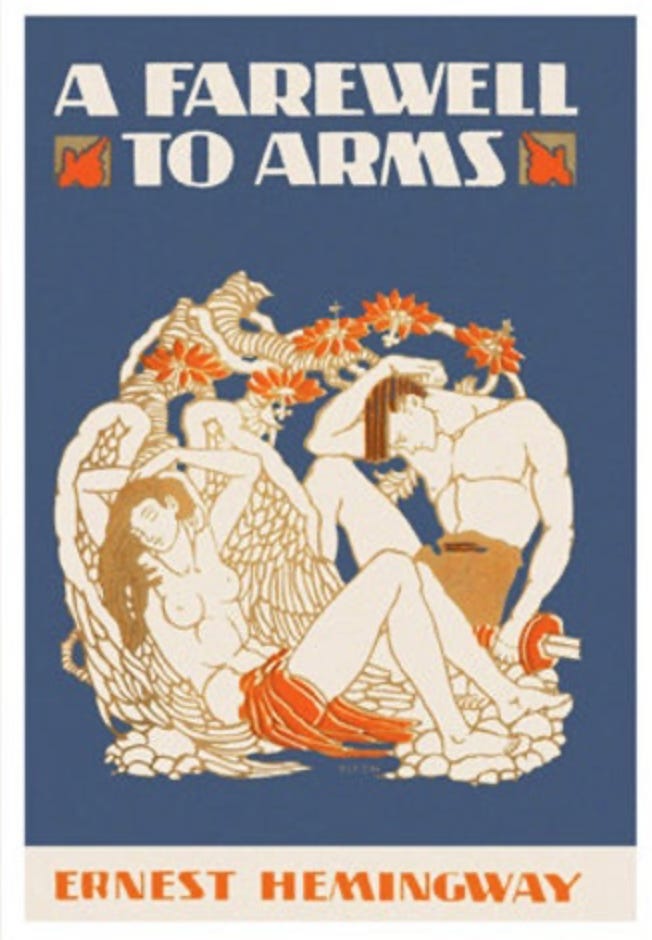
If you know where to look, A Farewell To Arms is full of coded and not-so-coded attacks on Mussolini and his ideals. Its characters also say things Il Duce would never want to hear:
“I was always embarrassed by the words sacred, glorious, and sacrifice and the expression in vain… Abstract words such as glory, honour, courage, or hallow were obscene beside the concrete names of villages, the numbers of roads, the names of rivers, the numbers of regiments and the dates.”
Academics have made great sport of teasing out such references – but it isn’t the line-by-lines that most count. The thing that really matters is the entire novel.
“Please be sensible”
One of Mussolini’s chief projects was to build up an idea of Italian martial prowess. Central to this was the idea that during the First World War, Italian soldiers had fought bravely and victoriously. Those who had died were martyrs who voluntarily – gladly – gave their life for the future of Fascist Italy. They had wanted to fight and fighting had been glorious.
In other words, Mussolini wanted to rewrite history and lie and lie about the recent past. Anything that ran counter to his narrative had to be expunged from the record – most notably the horrific events of the battle of Caporetto.
This battle was one of the greatest defeats in Italian military history. In the Autumn of 1917, its forces were driven back from Slovenia nearly all the way to Venice. Many thousands were killed and injured. 250,000 were captured. Unknown hundreds of thousands deserted – meaning that the army went from 1,800,000 troops down to 1,000,000.
The desertions, especially, made a mockery of Mussolini’s propaganda – and his response was to forbid all mention of them. He wanted the entire episode wiped from collective memory. No one was allowed to write about it, or even talk about it – as Hemingway himself explained in a letter to his editor Maxwell Perkins: “Caporetto has been abolished in Italy – It is not allowed to be referred to and it is not mentioned in histories of the war.”
Hemingway’s response was to centre an entire novel around this unmentionable defeat7.
He did not, notably, write about his own time on the Italian front in 1918, when the tide had actually turned and the Italian army was winning.
He instead focussed on the thing that Mussolini most wanted forgotten, the “gigantic” retreat, when “the whole country was moving, as well as the army”, presenting it in all its horrific and shameful detail:
The Italians were even more dangerous. They were frightened and firing on anything they saw. Last night on the retreat we had heard that there had been many Germans in Italian uniforms mixing with the retreat in the north. I did not believe it. That was one of those things you always heard in the war. It was one of the things the enemy always did to you. You did not know any one who went over in German uniform to confuse them. Maybe they did but it sounded difficult. I did not believe the Germans did it. I did not believe they had to. There was no need to confuse our retreat. The size of the army and the fewness of the roads did that. Nobody gave any orders, let alone Germans.
Pointedly, Hemingway writes all this from the point of view of a deserter who makes “a separate peace.” He shows that this character was not only right to leave the war, but that he also had no other choice. He also, repeatedly makes mockery of the kind of Italian valour that Mussolini wanted to promote.
“I feel like a criminal. I’ve deserted from the army,” the narrator says to his fiancée.
“Darling, please be sensible,” she replies. “It’s not deserting from the army. It’s only the Italian army.”
Ouch.
The whole thing is one gigantic fuck you to the dictator – and it’s one that was heard loud and clear. Mussolini immediately had the book banned in Italy – and it remained out of print there until after Mussolini beat his own retreat and had his appointment with death.
By that time, of course, Hemingway had sold millions of copies of this book and seen it turned into a film.
He had also been proved painfully and abundantly right. He had spent plenty of the 1930s warning again and again that Mussolini and Hitler were threats to peace – and that the forthcoming war would be horrific: “In modern war there is nothing sweet or fitting in your dying. You will die like a dog for no good reason.”
Even so, he took up arms himself, first against Franco, then in France during the Nazi retreat.
Hemingway was not fooled by fascism. He knew what it meant - and he knew how to respond to it.
On this, at least, he was exemplary.
A reference to a corps in the Italian army: https://en.wikipedia.org/wiki/Bersaglieri
Which Hemingway described in another, and already angrier, 1922 article as “a rabble of black-shirted, knife-carrying, club-swinging, quick-stepping nineteen-year-old potshot patriots.”
It has crossed my mind that Hemingway made up this detail. Was this a novelist’s flourish. The knowing detail that would crystallise the character of the man in one brushstroke? The thing that revealed the truth even if it wasn’t quite real? It’s also worth saying that Mussolini was actually widely read and thought of himself as an intellectual. He had even written a romance novel. But then. It’s not impossible that this happened. Not impossible that this awful poser might pull such a pose.
This was an idea he shared with no less a genius than PG Wodehouse, who wrote strikingly similar passages about Roderick Spode and his black-short-sporting bounders - including this famous put down from Bertie Wooster (surely one of the finest moments in the Western Canon):
The trouble with you, Spode, is that just because you have succeeded in inducing a handful of half-wits to disfigure the London scene by going about in black shorts, you think you’re someone. You hear them shouting ‘Heil, Spode!’ and you imagine it is the Voice of the People. That is where you make your bloomer. What the Voice of the People is saying is: ‘Look at that frightful ass Spode swanking about in footer bags! Did you ever in your puff see such a perfect perisher?’
Several of these anti-fascist quotes from Papa were helpfully gathered in a paper by Anders Greenspan at Texas A&M Univeristy-Kingsville: https://iafor.org/journal/iafor-journal-of-arts-and-humanities/volume-8-issue-2/article-2/
Translation: What does the homeland tell you?
Of course, this wasn’t the only reason he wanted to write about Caporetto. Nothing is that simple. But you can be sure that Hemingway took strength from knowing how much Mussolini would hate it - and knowing how important it was to set the record straight.
That was fascinating - thank you.
Really enjoyed this, Hemingway had no illusions about fascism at all